
Cable Shrugs: The Upper Trap Builder That Fixes What Barbell Shrugs Miss
Most lifters treat shrugs as a loading contest. Stack the bar, hitch it a few inches, count the plates, move on. There’s nothing wrong with that — heavy barbell and dumbbell shrugs belong in nearly every program, and they’re the right tool when the goal is raw load on the upper back. But if you’ve been hammering heavy shrugs for years and your traps still look flat from the side, the problem usually isn’t the weight. It’s the direction you’re pulling.
Cable shrugs solve that problem. They aren’t the heaviest shrug variation you’ll ever do, and they aren’t supposed to be. What they give you instead is constant tension through the entire range, a resistance angle that pulls you forward, and a shrug path that travels up and back rather than straight up and down. That combination produces a quality of contraction that’s genuinely hard to replicate with free weights, and it’s why this movement has earned a permanent slot in the accessory work at our gym.
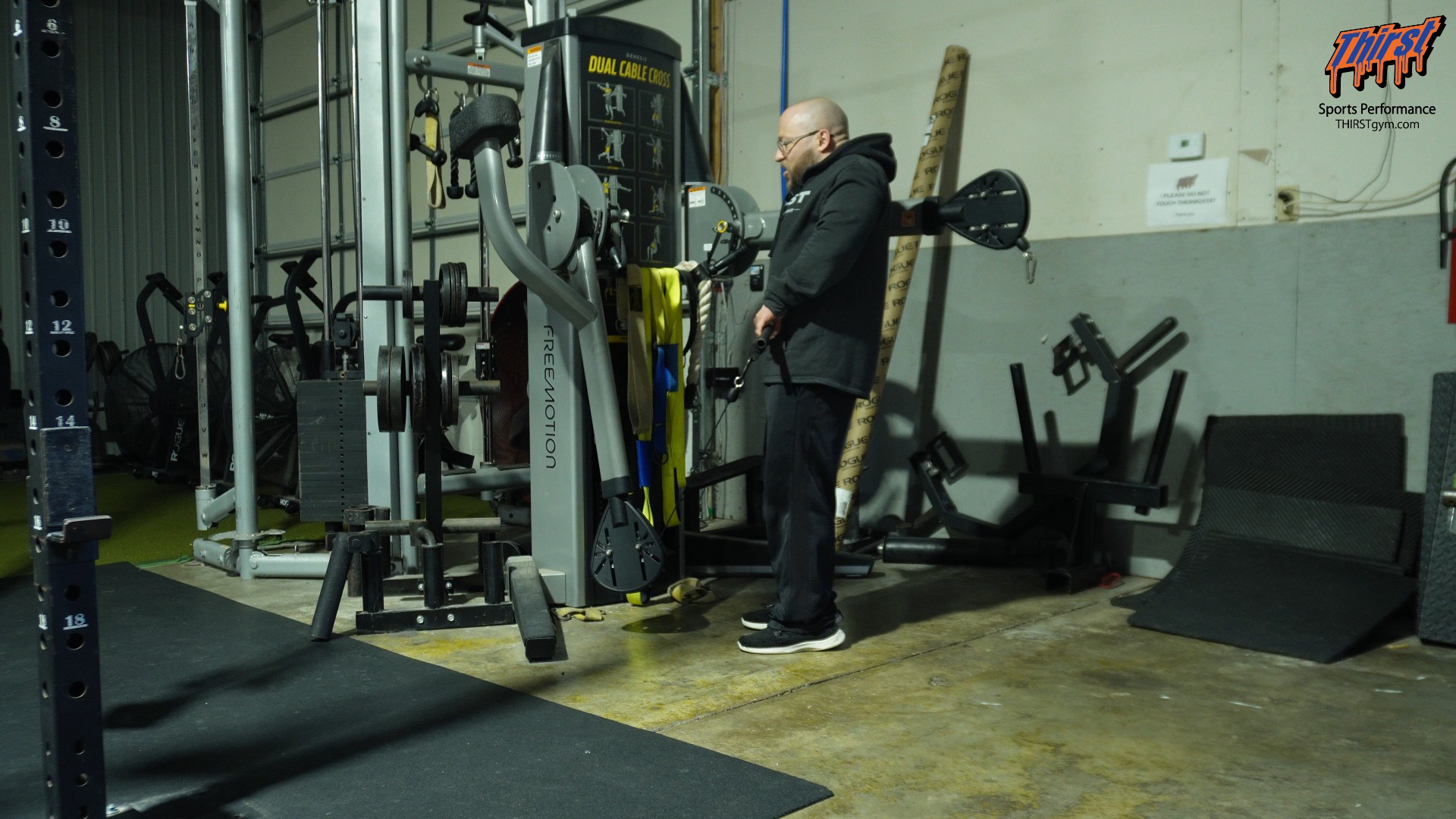
Watch the video below on how to maximize this exercise.
Why Cable Shrugs Belong in Your Program
The trapezius is not a single muscle doing a single job. The upper fibers elevate the shoulder girdle, the middle fibers retract the scapula, and the lower fibers depress and upwardly rotate it. A standard barbell shrug loads the upper fibers almost exclusively, and it loads them along a vertical line dictated by gravity. That’s useful, but it’s incomplete. The thickness you see on a well-developed upper back — the look where the neck starts to disappear into the shoulders — comes from training elevation and retraction together, not in isolation from one another.
A cable, unlike a barbell, doesn’t have to pull straight down. When you set the pulley low and step away from the machine, the line of resistance now runs forward and down at an angle. To complete the rep, you have to elevate the shoulder girdle and pull the shoulder blades together against that forward pull. You’ve turned a single-function movement into a movement that asks the upper and middle traps to work at the same time, which is a much closer match to what those muscles actually do when they’re doing their job on the platform or the mat.
The second advantage is tension. A free-weight shrug has a dead spot at the bottom — the bar hangs, the traps relax, and the stretch position carries no meaningful load. A cable never unloads as long as you’ve stepped far enough away from the stack. The muscle is under tension at the top of the shrug, through the eccentric, at full stretch, and on the way back up. For a muscle group that responds well to time under tension and high-quality repetition, that matters more than the number on the pin.
Equipment and Setup
You need a standard cable column with an adjustable arm dropped to the lowest setting, near the floor. Any attachment will work, and this is a movement where the attachment genuinely comes down to preference and availability. A straight bar is the most common choice. An EZ curl bar is excellent — the angled grip sits more comfortably in the hands and keeps the wrists neutral, which becomes noticeable once you’re running sets of fifteen or twenty. Strap-style attachments like a Spud Inc. strap are outstanding here as well, because the flexible material lets the hands settle into a natural position rather than being locked into a fixed bar. A rope, a lat bar, or even two single handles all work. Use what your facility has.
Grip the attachment double overhand. That’s the default and it’s what I use. If your grip gives out before your traps do — which is common on higher-rep sets — a mixed grip is a perfectly acceptable adjustment. Straps are also fair game. Grip endurance is a worthwhile thing to train, but not at the expense of the actual target of the exercise. If you’re stopping sets because your hands are opening up, fix the grip issue and let the traps do the work.
The Step That Makes the Exercise Work
Here’s the detail most people skip, and it’s the one that determines whether this movement does anything for you.
After you pick up the attachment, step away from the machine. Not six inches. A solid foot or two, far enough that you can feel the cable actively pulling you toward the column. Your body should be resisting a forward pull the entire time you’re holding the handle.
This accomplishes two things. First, it guarantees the weight stack never bottoms out at the end of the eccentric, so the traps stay loaded in the stretched position instead of getting a rest at the bottom of every rep. Second, and more importantly, it changes the resistance vector. With the cable pulling you forward, a straight-up shrug is no longer the path of least resistance. To finish the rep cleanly you have to shrug up and back, which drags the middle traps and rhomboids into the movement alongside the upper fibers. That’s the whole reason to do this exercise instead of grabbing dumbbells.
From there, set your stance about hip-width, brace lightly through the midsection, and keep the chest tall. Your arms hang long and stay long — they’re hooks, not levers.
Executing the Repetition
Start from a full stretch with the shoulders relaxed downward and the cable under tension. Drive the shoulders straight up toward your ears while simultaneously pulling the shoulder blades together and back. The mental picture I give athletes is to make the ears disappear, then make the neck disappear. You’re trying to close the gap between the shoulder and the earlobe while the shoulder blades squeeze behind you.
Hold the top position for a full one-count. Not a bounce, not a tap — an actual pause where you can feel the traps clamped down hard. Then lower under control and let the arms get long again, allowing the shoulder blades to travel up and forward into a genuine stretch. Pause for a one-count there as well. That loaded stretch position is where a lot of the value in this exercise lives, and rushing through it is the fastest way to waste a set.
Then pull back up and repeat. The cadence should be deliberate: pause at the top, pause at the bottom, no momentum in between. If you can’t hold both pauses, the weight is too heavy for the variation, which is a strange sentence to write about a cable shrug but it happens.
Keep the head neutral throughout. There’s a temptation to crane the chin forward or roll the head back to “help” the shrug, and neither does anything productive for the traps. Neck position stays stacked over the shoulders.
And do not roll the shoulders. Rolling shrugs get passed around as a way to hit more of the trap, but all they really do is spend part of the range of motion in a position where the muscle isn’t producing much force, while adding unnecessary stress to the shoulder. Shrug up, squeeze back, lower under control.
Common Mistakes
The most frequent error by far is not stepping far enough away from the machine. If you’re standing directly under the pulley, you’ve just built a worse dumbbell shrug — the resistance is vertical, the stack bottoms out, and you’ve lost the two advantages that made the exercise worth doing. Step back until you feel the pull.
The second is bending the elbows. As fatigue sets in, lifters start adding a small upright-row motion to keep the reps moving. That shifts work into the biceps and delts and takes it out of the traps. The arms stay straight and passive from the first rep to the last.
Third is skipping the pauses. High-rep trap work is easy to turn into a bouncing, half-range grind. Every rep you cut short is a rep that didn’t need to exist. Fewer reps done with a real hold at both ends will outproduce a rushed set of twenty every time.
Fourth is excessive trunk lean. You need to resist the forward pull with a tall chest, not lean back into a quarter-deadlift position to create leverage. If you find yourself leaning away to move the weight, the load is too heavy and the traps aren’t the limiting factor anymore.
Getting the Load You Need
The honest limitation of this exercise is that most cable stacks won’t get heavy enough for a strong lifter. That’s the trade-off for constant tension, and it’s worth accepting — but there are ways around it.
The simplest is to double up your cables. On a functional trainer or any dual-column setup, grab both low pulleys at once with a single attachment. On our machine that takes an 80-pound maximum to 160, which covers almost everyone for this movement. If you’re working with a single column, look for the heaviest stack in the building. A lat pulldown or seated row station often carries a much heavier stack than a standard cable tower, and many of them allow a low-pulley or floor-level setup that reproduces the same angle with substantially more weight available.
If you’ve genuinely maxed out every option in the building for twenty clean repetitions, that’s your cue to either move to a different variation for your heavy trap work or accept this one as a finisher rather than a primary. Which brings us to programming.
Programming Cable Shrugs
Treat this as a low-level accessory movement, not a centerpiece. Ten to twenty repetitions is the right range for almost everybody. The constant tension and the double pause make even moderate loads feel substantial, and the higher rep ranges suit both the muscle fiber makeup of the traps and the practical reality of limited stack weight.
Two to four sets is plenty. The most natural placement is at the very end of an upper body day, after your pressing and rowing work is finished. By that point you’re not trying to move maximal load anyway, and this lets you accumulate a meaningful volume of high-quality upper trap work without eating into the energy you need for the heavy lifts earlier in the session. Run it for two or three sets, get a strong contraction on every rep, and call it a day.
For progression, add reps before you add weight. Work from sets of ten toward sets of twenty at a given load, then move the pin, then repeat. When you hit the ceiling of the machine at twenty clean reps, double the cables and start the cycle over. Adding a longer pause at the top — two or three seconds instead of one — is another effective progression that costs you nothing in equipment.
Two to three exposures per week is more than most people need. The traps recover quickly, but they’re also getting hit indirectly by every deadlift, row, carry, and overhead press in your program. Account for that before you add more.
Who Gets the Most Out of This
Combat sports athletes. Wrestlers, grapplers, and MMA athletes live in positions that demand a strong, thick upper back and a neck that’s protected by the musculature around it. The up-and-back shrug pattern directly trains the retraction and elevation strength that shows up in hand fighting, underhooks, and defending from bad positions. For this population I’d program cable shrugs year-round.
Powerlifters. Upper trap and mid-back thickness supports bar position on the squat, creates a more stable shelf for the bar, and contributes to lockout strength on the deadlift. The constant-tension quality here also makes it a joint-friendly option during heavy training blocks when another set of maximal shrugs isn’t what your recovery needs.
General fitness clients. This is one of the safest, most teachable ways to train the upper back. There’s no bar to load, the setup is quick, the movement is simple to coach, and the resistance curve is forgiving. For anyone dealing with desk-posture complaints, the retraction component makes it more useful than a straight vertical shrug.
Youth and beginner athletes. Cables are an excellent introduction to resistance training for younger lifters. The load is controlled by a pin, the movement pattern is hard to butcher, and the emphasis on pausing and controlling teaches the body awareness that transfers to everything else.
Older adults. The combination of low joint stress, adjustable load in small increments, and strong upper back recruitment makes this a smart choice for maintaining posture and shoulder girdle function.
Progressions and Regressions
If a full cable shrug is too much — a beginner, someone returning from a shoulder issue, or an athlete in a deload — regress by shortening the step away from the machine and reducing the backward pull, turning it into a more vertical, lower-demand shrug. Single-arm cable shrugs are another good regression that lets you address side-to-side differences and keeps the total load manageable.
To progress beyond the standard version, add the top-position pause duration, double the cables as described, or move to a leaning cable shrug where you increase the angle of the pull by stepping further back and allowing a slight forward lean at the torso, which lengthens the moment arm. From there, if the stack simply isn’t enough, transition your heavy trap work to barbell shrugs, trap bar shrugs, or heavy dumbbell holds, and keep cable shrugs in the rotation as the quality-contraction finisher they’re best suited to be.
The Bottom Line
Cable shrugs are not about load. If you want to move the most weight possible, that’s what barbells and dumbbells are for. What this variation offers is a resistance angle you can’t get from gravity alone, constant tension through the entire range, and a shrug path that pulls up and back to recruit the middle traps alongside the upper fibers. Done with real pauses at both ends and enough distance from the machine to feel the pull, it’s one of the best ways to feel the traps actually working — and over time, one of the more reliable ways to build the thickness that makes the neck disappear.