
The Feet-Elevated Crunch: How to Isolate Your Abs and Build a Bulletproof Mind-Muscle Connection
Most people have done a crunch at some point, and most people have done it poorly. They yank their neck, throw their torso up with momentum, or lean so heavily on their hip flexors that their abs barely get a vote. The feet-elevated crunch strips all of that away. It’s one of the most targeted, honest ab exercises you can program, and when it’s done right, there’s nowhere for your midsection to hide. This is a movement built entirely around quality of contraction rather than ego, and that’s exactly why it belongs in your training.
In this guide, I’ll walk you through why the feet-elevated crunch works so well, how to set it up, how to perform it with strict technique, how to load it when bodyweight stops being challenging, and who benefits most from adding it to their program.
Watch the video below on how to maximize this exercise.
Why the Feet-Elevated Crunch Works
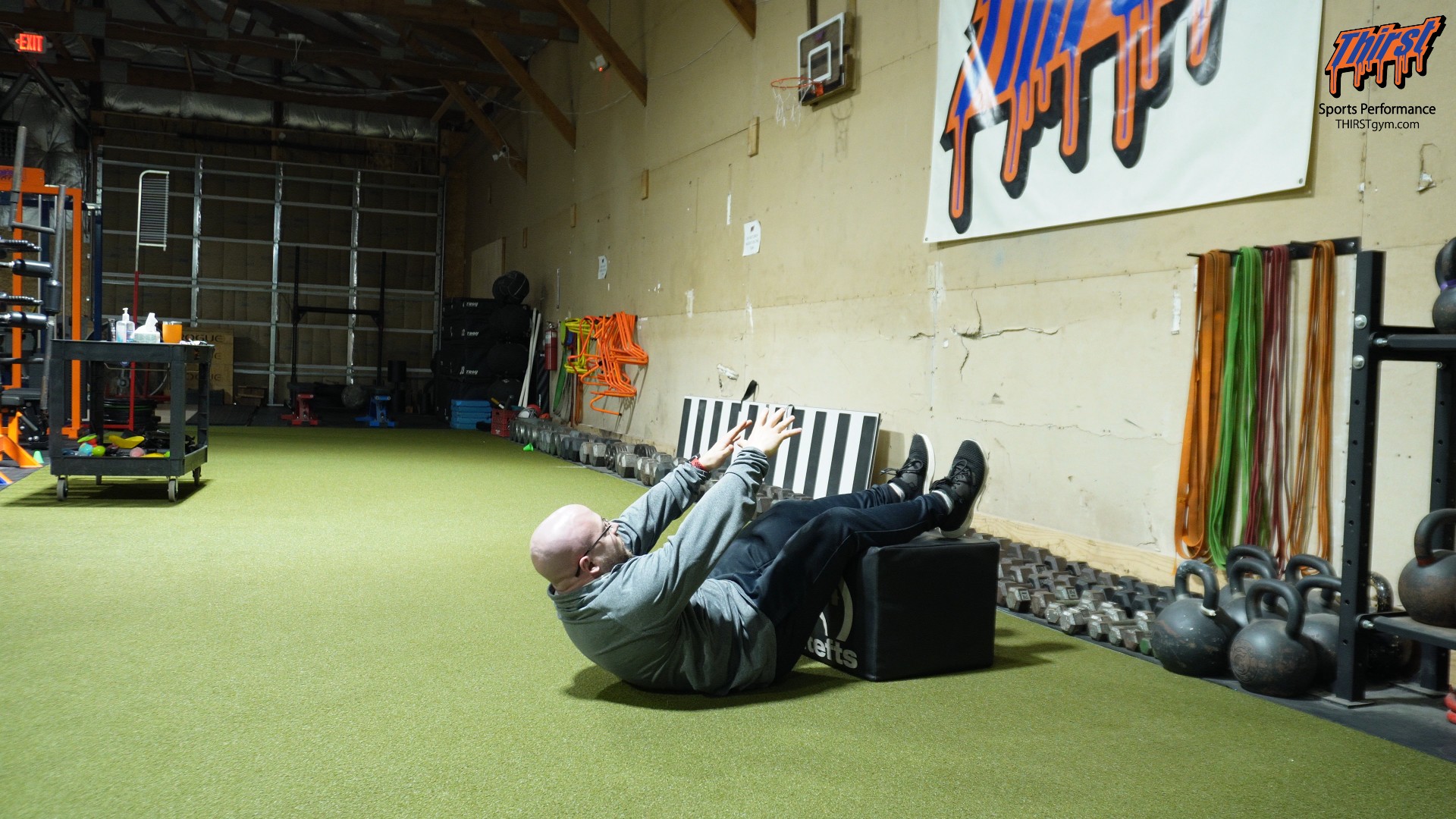
The magic of this exercise comes down to what it removes from the equation. When your feet are elevated on a bench, box, chair, or couch with your knees bent at roughly a 90/90 position, your legs are fully supported and can relax. They aren’t bracing, they aren’t pulling, and they aren’t contributing to the movement. That single setup detail changes everything.
With your legs out of the picture, two of the biggest “cheaters” in traditional ab training get shut down. The first is the hip flexors. On decline sit-ups and many floor variations, the hip flexors take over a huge share of the work, and a lot of trainees become extremely reliant on them without realizing it. There’s nothing inherently wrong with training the hip flexors, and they deserve some attention of their own, but if your goal on a given exercise is to build the abdominals, you don’t want them stealing the show. The second cheater is the lower back. By keeping your pelvis tucked underneath you and your low back completely flat against the floor, you eliminate the arch-and-extend pattern that turns a crunch into a full-body heave.
What’s left is a small, deliberate range of motion driven almost entirely by the rectus abdominis, the “six-pack” muscle responsible for flexing the spine and pulling your ribs toward your pelvis. That’s the muscle you’re here to train, and this setup forces it to do the job.
What You’ll Need
The equipment demand here is refreshingly low. All you need is something to elevate your feet on that comfortably supports your legs below the knee. A flat bench or a plyo box is ideal, but a couch, a sturdy chair, or an ottoman works just as well. Don’t overthink the exact angle. If you want to be a stickler and hit a clean 90/90 with your hips and knees, that’s great, but it isn’t a requirement. As long as your legs are supported below the knees and can fully relax, you’re set up correctly.
You’ll also want a bit of floor space and, optionally, a dumbbell or kettlebell if you plan to load the movement later. That’s it.
How to Perform the Feet-Elevated Crunch
Start by lying on your back and placing your lower legs on top of your bench or box so your feet are elevated and your legs are relaxed. Settle your pelvis underneath you and press your lower back completely flat into the floor. This flat-back, tucked-pelvis position is the foundation of the entire exercise, so take a second to confirm it before you move.
Reach your arms straight out in front of you toward your knees. Your arms aren’t there to yank you up. They serve as a reaching tool that helps you extend a little further into the contraction and keeps your focus on curling forward rather than jerking upward.
Now actively curl. Pull your ribs down toward your pelvis, reach your hands as high and as far forward as you can using your abs, and think about shortening the distance between your ribcage and your hips. This is a curling action, not a launching action, which is exactly why I prefer the word “crunch” over “sit-up.” At the top, pause and hold for a brief one-count while you squeeze, feeling a strong, quality contraction through your midsection. Then lower yourself back down under control.
Keep the range of motion small and intentional. You are crunching at the midsection, not throwing your whole torso off the ground. If you do this correctly, you will feel it directly in your abs, and there won’t be any question about whether they’re working. This is not a rep-count exercise where the number on the board matters most. It’s a feel exercise, and strict execution is the entire point.
Adding Load to the Movement
Bodyweight is the right starting place for most people, and for many trainees, a set of strict bodyweight reps will land somewhere in the 10-to-20 range before form starts to break down. Once that becomes easy, you have two great ways to level the exercise up.
The first is to add external load. Grab a dumbbell or kettlebell and hold it straight overhead, positioned over your chest, keeping your arms locked in that same reaching line. As you crunch, move the weight with you while keeping your arm position fixed. The critical detail is that you don’t use the weight to pull yourself forward or to gain extra reach. The load is there to increase the demand on your abs, not to create momentum. Same strict crunch, same one-count hold at the top, just heavier.
The second option requires no equipment at all. Simply extend the hold at the top of each rep to a solid two- or three-count. That extra time under tension dramatically increases the difficulty and reinforces the mind-muscle connection without adding a single pound.
Common Mistakes to Avoid
The most common error is turning a crunch into a sit-up. If you feel yourself hinging from the hips and rising all the way toward your knees, you’ve likely re-recruited the hip flexors and lost the isolation that makes this exercise valuable. Keep the movement small and keep your low back flat.
The second mistake is using the arms and momentum to swing yourself up. Your hands reach; they don’t pull. If you find yourself flinging your arms to generate lift, slow down and reset. The third mistake is rushing the reps. Because the range of motion is so short, speeding through it is the easiest way to make the exercise feel like nothing. Own each rep, pause at the top, and lower with control. And finally, watch the low back. The moment your pelvis untucks and your lumbar spine arches off the floor, you’ve drifted out of position.
Who This Exercise Is For
This movement is genuinely versatile. For beginners, it’s one of the best tools available for learning to actually feel the abdominals contract, which is a skill many people have never developed. That mind-muscle connection carries over to nearly every other core exercise you’ll ever do.
For intermediate and advanced lifters, including powerlifters and physique-focused athletes, it’s an excellent accessory for building the rectus abdominis with strict, targeted tension, and it’s easy to progressively overload with load or extended holds. For combat sports athletes such as wrestlers, grapplers, and MMA competitors, developing conscious control of the abdominals and reducing over-reliance on the hip flexors can pay off in trunk stability and positional strength. And for general fitness clients and youth athletes, it’s a low-equipment, joint-friendly way to train the core safely without the lower-back stress that decline work sometimes introduces.
If you love decline sit-ups, keep them; they’re a perfectly good exercise. But the feet-elevated crunch fills a different role. It’s about isolation and quality, and it’s a great way to make sure your abs are the ones doing the work.
Programming the Feet-Elevated Crunch
You can plug this into your training a few different ways depending on your goal. For general core development, two to four sets of 10 to 20 strict bodyweight reps at the end of a session works well. When bodyweight becomes too easy, hold a dumbbell or kettlebell overhead and drop into a working range of 8 to 15 hard reps, or keep it bodyweight and extend your top-position hold to a two- or three-count on every rep.
Train it two to three times per week with at least a day between sessions, and prioritize execution over volume every single time. Because the range of motion is short and the tension is high, a handful of genuinely strict reps will always outperform a long set of sloppy ones.
Final Thoughts
The feet-elevated crunch isn’t flashy, and it isn’t meant to be. It’s a strict, isolated, honest ab exercise that rewards discipline and punishes ego. Set your feet up, flatten your back, curl your ribs down, hold the squeeze, and control the descent. Do that consistently, add load or time under tension as you progress, and your abs will have nowhere to hide.