

The Truth About Progressive Overload: 7 Myths That Are Sabotaging Your Training Results
Progressive overload might be the most talked-about principle in all of strength and conditioning, and somehow it’s also one of the most misunderstood. Ask almost anyone what it means and you’ll get the same answer: just add five pounds to the bar every week. That’s it. That’s the whole strategy. And that oversimplified message is exactly the problem I want to tear apart, because it’s quietly costing intermediate and advanced trainees real progress, and it’s leading coaches to write programs that stall out far earlier than they should.
Here’s a number worth sitting with. A 2019 meta-analysis published in the Journal of Strength and Conditioning Research examined progressive overload protocols across dozens of studies and found that load progression alone was one of the least reliable predictors of long-term hypertrophy and strength gain once trainees moved past the novice stage. Read that again. The single strategy the entire fitness industry sells as the answer turns out to be one of the weaker tools in the box once you’re no longer a beginner.
So why does the “add weight or you’re failing” message persist? Because it’s clean and marketable. It fits on an Instagram graphic. It requires zero nuance, and it gives beginners a simple roadmap that feels like progress. The trouble is that it does a genuine disservice to intermediate and advanced lifters, and to the coaches trying to keep those athletes moving forward. This article breaks down seven specific myths about progressive overload, backs each one with what the research actually says, and leaves you with a more complete and effective framework for programming it, whether you’re training yourself or writing programs for clients.
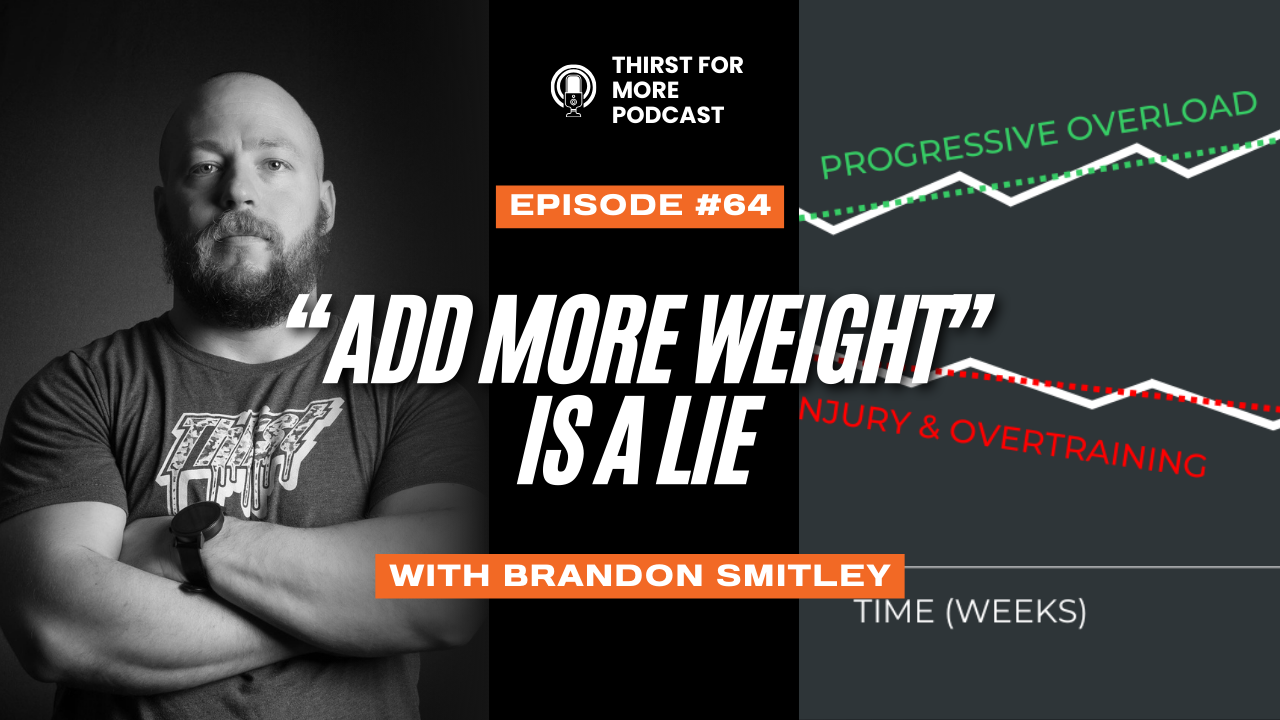
You can also watch the video below that goes along with this article.
What Progressive Overload Actually Means
Before we get into the myths, we need to speak the same language, because half the reason these misconceptions stick around is that people use the same term to describe wildly different things.
At its most fundamental level, progressive overload is simply the principle that to drive a continued training adaptation, you have to progressively increase the stress placed on the body over time. That’s the whole core idea. The stress must increase for the adaptation to continue. Simple enough.
The part everyone misses is what “stress” can actually look like. Load is only one option. You can also manipulate training volume, which is your sets times reps times load. You can manipulate training intensity, meaning the percentage of your one-rep max. You can adjust training density, which is how much work you complete in a given unit of time. You can use exercise variation to introduce new movement patterns or change the biomechanical demand. You can increase range of motion to load a muscle in a deeper stretch. And you can refine technique to eliminate energy leaks and make a given load more mechanically challenging on the target tissue. That’s six distinct categories of overload, and the industry has collapsed all of them into “add more weight to the barbell.” That collapse is the root problem, and nearly every downstream myth grows out of it.
For a bit of history: the term “overload” traces back to Hans Selye’s work on the General Adaptation Syndrome in the 1930s, and the progressive principle as applied to exercise was popularized by Thomas DeLorme in the 1940s during his rehabilitation work with World War II veterans. DeLorme’s protocol was specific, structured, progressive, and addressed multiple variables. Somewhere between his original work and the modern social media infographic, we lost all of that nuance. Let’s bring it back.
Myth 1: Progressive Overload Means Adding Weight to the Bar
This is the big one, and it spawns most of the others. Let me be fair up front: in the novice phase of training, adding weight is usually the most efficient form of progressive overload, and I won’t argue otherwise. When someone is brand new, their neuromuscular system is wildly inefficient, and small load increments produce large adaptations. This is the “beginner gains” window where you can practically do no wrong. Linear progression works beautifully here, which is exactly why 5×5 programs and Starting Strength–style templates are so popular for new lifters.
But past that beginner phase, the picture changes. A 2010 study by Krieger in the Journal of Strength and Conditioning Research examined single versus multiple sets and pointed to total volume, the overall amount of work done, as a primary driver of muscle growth independent of load. Then in 2017, Schoenfeld’s lab published work showing that training at moderate loads in the 8-to-12 rep range and training at heavier loads in the 1-to-5 range produced equal hypertrophy when total volume was equated. Within a fairly broad range, load simply wasn’t the determining factor for muscle growth.
Practically, this means that if you’re an intermediate or advanced trainee who believes progress only counts when the bar gets heavier, you’re almost certainly leaving hypertrophy on the table. You can drive meaningful growth by adding a set, adding two reps per set, trimming rest periods, or sharpening your mind-muscle connection to increase the relative mechanical tension in the working muscle. Think about how much more you can feel a leg extension or leg curl when you actually own the contraction.
To be clear, I’m not saying load doesn’t matter. It matters enormously, especially for strength, which is largely a neural expression, and loading the nervous system is non-negotiable for developing it. What I’m saying is that for hypertrophy, the story is far more nuanced than “add weight.”
Here’s the framework I use. Think of progressive overload in three tiers. Tier one is load-based progression: add weight when you can while keeping your technique intact. Tier two is volume-based progression: add sets or reps when load stalls or when the block calls for volume accumulation. Tier three is density- or quality-based progression: complete the same volume in less time, or achieve the same load with dramatically better technique and muscle recruitment. All three are valid. All three drive adaptation. The skill is knowing which tool to reach for and when, and sometimes that call comes down to seasonality, equipment access, or plain personal preference. Maybe your machine only jumps in 10-pound increments and you can’t make the next rep target, so you add eccentric tempo or a drop set to raise density instead. There’s always another lever.
Myth 2: You Must Progress Every Single Session
I can’t count how many clients have developed a genuinely dysfunctional relationship with training because they got trapped chasing progress session to session. As someone with a conjugate background, I understand the pull. But the analytical lifter who walks in every day expecting to add weight to every lift eventually collides with reality, because you cannot add five pounds to the bar every week for the rest of your life. When it stalls, they either push past what’s reasonable and get hurt, or they walk out feeling demoralized and convinced the session failed.
Here’s the physiological reality: adaptation doesn’t happen on a session-to-session timeline. Your body has no concept of that. It happens over weeks and months. The acute training response, the soreness, fatigue, and temporary performance dips, can actually mask the adaptations quietly accumulating underneath. The supercompensation model, which underpins most periodization, tells us there’s a window after training when fatigue clears and performance capacity rises above baseline. That window is what we chase for peaking, whether it’s a powerlifting meet booked months out or an athlete’s most important competition of the season.
That last point matters for athletes especially. You can’t peak for every event, particularly in sports that compete two or three times a week. You pick the big rocks, the sectional, the regional, the state tournament, the Final Four, and you accept that a random midweek meet might not be an optimal performance if it doesn’t compromise the end goal.
A 2018 review by Lorenz and Morrison in the Strength and Conditioning Journal made this explicit: trying to force a constant upward trajectory in any single metric across every session isn’t compatible with the supercompensation model and raises injury risk by starving recovery. You cannot keep the gas pedal on the floor every session and still expect progress every session.
This is exactly why undulating models, both daily undulating periodization (DUP) and weekly undulating periodization, perform so well in the literature. They intentionally vary the stimulus. You’re not trying to PR your squat on Monday if Monday is heavy triples, because Wednesday is higher-volume moderate load and Saturday is speed work. The progression lives in the block, not the individual session.
The coaching takeaway is important: stop judging a session by whether weight or reps went up. Judge whether it delivered the intended stimulus within the broader plan. Did they hit the prescribed RPE? Did they move well? Did they complete the full volume without cutting corners? Those are the meaningful markers, and the PR shows up when the block is built to allow it. This is the difference between coaches who keep athletes healthy and progressing for years and coaches who burn them out in six months by pounding the barbell every day.
Myth 3: If Some Overload Is Good, More Must Be Better
The logic goes: if adding one set is good, adding three must be three times as good. If five pounds is good, fifteen is better. This is the fastest route to overreaching and overtraining in the entire industry.
Those terms get misused constantly, so let’s define them. Functional overreaching is intentional, a planned block of elevated stress that exceeds current recovery capacity specifically so supercompensation can occur once the stress is pulled back. That’s a legitimate tool. Non-functional overreaching is what happens when that elevated stress runs too long without recovery. And clinical overtraining syndrome, involving genuine hormonal dysregulation, immune suppression, and psychological symptoms, can take weeks to months to resolve. A 2012 review by Kreher and Schwerzler in Sports Health described overtraining syndrome as producing performance decrements lasting more than two weeks alongside mood disturbance, elevated resting heart rate, sleep disruption, and shifts in hormonal markers like the testosterone-to-cortisol ratio. Some studies suggest full recovery can take six months or more.
I’ll add that true clinical overtraining is rare, and I’ve known very few people to genuinely reach it. It’s usually advanced athletes, because beginners and lower-level intermediates typically can’t generate enough neural demand to get there; they’re nowhere near their genetic ceiling. Advanced and elite athletes can, because they train harder, understand the variables, and sometimes push when they don’t need to.
The sneaky part is that “more” rarely shows up as someone training seven days a week at maximal loads. It shows up as a coach adding exercises every month after a clinic. It shows up as an athlete tacking extra sessions onto a structured program because they feel they should be doing more to earn a roster spot or playing time. It shows up as endless volume blocks with no corresponding deload.
The research on volume landmarks is instructive here. Work coming out of Mike Israetel and the Renaissance Periodization team, grounded in the hypertrophy literature, describes muscle-group-specific thresholds: minimum effective volume, maximum adaptive volume, and maximum recoverable volume. Training chronically above your maximum recoverable volume doesn’t just stop producing gains, it can turn catabolic, breaking down more tissue than you can rebuild. The sophisticated approach cycles between accumulation, intensification, and deload phases, which is exactly how block periodization operates. You’re not always going up, because biological systems don’t work that way. Even the stock market has corrections. Hormonal systems cycle, sleep architecture cycles, so why would we expect an endless linear climb in training stress to be sound?
Myth 4: The Same Progression Strategy Works for Everyone
This one might be the most dangerous, because it underpins so much cookie-cutter programming and one-size-fits-all certification content. I understand why certifications teach simplified models; they’re giving practitioners a starting point. The problem is coaches who never evolve past that introduction, who stay at the bottom rung and never dig into the weeds or talk to other professionals who could deepen their understanding.
Start with training age. Novice trainees, broadly anyone in their first six months to a year of structured training, can progress through simple linear progression just fine. The neuromuscular system is inefficient enough and the adaptation reserve large enough that week-over-week load progression is entirely feasible. This is the physiological basis for beginner programs that add weight every session.
Intermediate trainees, roughly one to three years of consistent hard training, need weekly progression models. The reserve is still meaningful but the nervous system is more efficient, the muscles larger and stronger, the tendons more resilient, and recovery demands higher. Weekly loading models like DUP and block periodization fit these lifters well, and it’s no coincidence that DUP-based powerlifting programs are so popular; most people running them and seeing big gains fall in that one-to-four-year window with reserve still in the tank.
Advanced trainees, generally three to four years of hard structured training and up, often need monthly or longer cycles to drive meaningful adaptation, because even small absolute gains demand enormous stress. An Olympic lifter might spend a full four-year cycle trying to add two and a half kilograms to their total. When I broke my first world record squat, I added one kilogram after eighteen or nineteen months of training. As a percentage, that’s tiny, which is exactly the point: advanced athletes have to think in big timelines to make small progress, using varied methods to get there.
Then there’s chronological age, where I see programming that genuinely frustrates me. Research from Deschenes published in Sports Medicine in 2004 documented significant age-related changes in neuromuscular function, decreased motor unit recruitment efficiency, slower contractile velocity, and longer recovery times, beginning as early as the mid-thirties in untrained individuals. A 2016 meta-analysis in the Journal of Aging and Physical Activity confirmed that older adults need longer between-session recovery to achieve the same adaptation as younger trainees. Applying a novice linear progression to a 40- or 50-year-old intermediate isn’t just suboptimal, it can be harmful. These lifters need longer recovery windows, often benefit from lower-frequency higher-effort sessions rather than high-frequency moderate work, and need smaller, more carefully managed increments.
Finally, individual response variability. The HERITAGE Family Study found that among sedentary adults given the identical aerobic protocol, VO2 max responses ranged from essentially zero improvement to over 40 percent. Same protocol, completely different outcomes. The same is true in resistance training: some people are high responders who look at a barbell and grow, while others grind for every ounce of progress. Everyone is an n of 1. You can absolutely use shared frameworks to get the ball rolling, but over time the program should mold to the individual, their size, structure, training background, and recovery demands, not the other way around.
Myth 5: If You’re Sore, You’re Making Progress
This myth costs people real results, whether through missed sessions from excessive soreness, burnout, or simply chasing the sore feeling instead of actual performance markers. Sore hamstrings the day after feel like proof you worked hard, and that instant gratification is seductive. But as the saying goes, any idiot can make another idiot sore.
Delayed onset muscle soreness is primarily driven by the inflammatory response to eccentric mechanical damage, which is why RDLs wreck people early on. But the repeated bout effect, well documented in the literature, tells us that after the first exposure to a novel stimulus, subsequent exposures produce progressively less soreness. That isn’t a sign adaptation stopped; it’s a sign the protective cellular and cytoskeletal adaptations that blunt damage have kicked in. A 2003 study by McHugh in the Scandinavian Journal of Medicine and Science in Sports made this clear: reduced soreness with repeated exposure is a sign of adaptation, not a sign the stimulus stopped working.
This is also part of why the first week of a new training block often feels manageable. When I introduce a new block, I usually pull intensity and volume down slightly in week one, which is why I like the term “reload week.” New movement patterns are more likely to generate soreness, and I want to nail technique and dial in loads, especially with RPE, before ramping up. That’s not lost progress. That’s smart sequencing.
The industry has this inverted. “No pain, no gain” and “no soreness, no progress” run directly opposite to what biology tells us. Your veteran clients who don’t get sore from regular training are showing a normal adaptive response, not a plateau. And constantly rotating exercises just to chase novel soreness is evidence of poor strategy and, honestly, poor programming. Novelty has a role in preventing accommodation; as a conjugate guy I understand that deeply. But the variable you track is performance, not soreness.
Myth 6: Technique Improvements Don’t Count as Overload
This one is subtle but has big implications, especially for intermediate lifters who’ve hit a wall on load progression and need another way forward. The key concept is that mechanical tension is the primary driver of hypertrophic signaling at the cellular level, activating the mechano growth factor and mTORC1 pathways that drive protein synthesis, something John Meadows talked about often.
Here’s the part people miss: mechanical tension isn’t simply a function of external load. It’s a function of the load transmitted to the contractile tissue of the target muscle. Picture a client squatting 315 with an excessive forward lean, dumping most of the work onto their lower back. The tension actually reaching their quads is far less than it would be in a more upright pattern with the same bar weight. Correcting that lean, improving knee tracking, and hitting better depth increases quad tension at the identical external load. Nothing changed on the bar, but the target musculature is now under more stress, and more stress is progression. This is why lifters who make meaningful technical changes suddenly start feeling their quads, hips, or glutes working in ways they never did before.
Tempo works the same way. A 2012 study by Schoenfeld and colleagues found that deliberate eccentric tempo, a controlled three-second lowering, increased muscle damage and metabolic stress compared to uncontrolled eccentrics at matched loads. Slowing the eccentric without adding weight raised the overload on the target muscle. So before you reach for more weight or more volume with a plateaued client, ask whether a technique improvement could make the current load more effective for the muscle you’re trying to develop. Often it can, and addressing it first improves long-term outcomes while lowering injury risk. Layer tempo work on top of that and you can keep progressing a block without the barbell ever moving up.
Myth 7: Overload Only Applies to Strength and Hypertrophy
This is a compartmentalization problem I see a lot in coaches with a strength bias, and as a former powerlifter I’ll admit the tendency. We get so fixated on moving iron that we forget progressive overload is domain-general when you step back.
Take conditioning. If a client runs the same three-mile route at the same pace every week, they’ll plateau just as surely as if they squatted 315 for three sets of five for a month straight. Progressive overload in an aerobic context means progressively increasing volume (mileage), intensity (pace or heart rate zones), or complexity by adding intervals, fartleks, or threshold work. Same principle, different expression.
Mobility is no different. Hold a hip flexor stretch for 30 seconds, three times, the same way for six months and you’re not overloading the tissue at all. Progressive overload here means increasing time under tension in the stretched position, adding external load, or carefully expanding range of motion over time. Loading a deep squat by holding a 10- or 15-kilogram plate and rocking through the bottom stresses the tissue more than an unloaded hold and helps you sink deeper. Work from Kassiano and colleagues in 2022 highlighted the hypertrophic potential of training at long muscle lengths, and loading a lengthened position can drive mobility changes too. I’d caution against dying on any single hill, though; strength at length is valuable, but it blends with other proven mobility principles rather than replacing them.
For sport-specific work, and I mean actual skill work on the field, not gimmicks on a Bosu ball, progressive overload means increasing technical complexity, decision-making under fatigue, and the difficulty of practice conditions so they better mirror game intensity. Even something as simple as a slightly heavier baseball bat to overload a swing follows the principle, with obvious diminishing returns. The principle doesn’t change. Only its expression does.
Putting It All Together
Seven myths, seven corrections. Load is one of six overload variables, not the only one. Progression happens over blocks, not individual sessions. More is not always better, because training above your maximum recoverable volume turns catabolic. One strategy does not fit all; training age, chronological age, and individual variability all demand individualized progression. Soreness is not a progress marker, and its reduction signals successful adaptation. Technique that increases mechanical tension at the same load is legitimate overload. And the principle governs every physical adaptation, from conditioning to mobility to sport skill.
Here’s what I want you to do with all of this. Look at your current programming, or the programs you write for clients, and ask one honest question: am I using all six overload variables, or am I defaulting to load progression as my only tool? If it’s the latter, you now have five other levers to reach for when load stalls or isn’t appropriate, and that’s often the entire difference between an athlete who keeps progressing and one who’s stuck.
A quick real-world example. One of my remote clients, Landon, has been running deficit deadlifts against bands for three or four blocks now. We’ve beaten that exercise into the ground, and his deadlift keeps looking better with more speed off the floor. I keep it in precisely because it’s working, even while I vary the sets, reps, volume, RPE, and effort around it. I wouldn’t be surprised to see him near a 700-pound pull before long. We only found that because we were willing to experiment. If something works, run it while the stove is hot, and keep experimenting so you find the next thing that does.
Need help improving your physique, building muscle, and/or losing fat? Contact us to see how we can help you!