
The Glute Ham Roller Ab Fallout: A Complete Guide to Building Anti-Extension Core Strength
When most people think about training their abs, they picture crunches, sit-ups, and endless variations of curling the torso toward the knees. The problem is that this approach trains the core to do the one thing it rarely needs to do well in sport and in the weight room: flex the spine. The real job of your midsection is to resist movement — to stay rigid and stacked while your arms and legs generate force around it. That’s exactly what the glute ham roller ab fallout is built to develop, and it’s one of the most effective anti-extension exercises you can add to a training program.
Whether you’re a wrestler scrambling on the mat, a powerlifter bracing under a heavy bar, or someone simply trying to build a stronger, more resilient midsection, the ab fallout deserves a place in your rotation. Below, we’ll break down what makes this exercise so valuable, exactly how to perform it, the mistakes that quietly rob you of results, and how to program it for real, lasting progress.
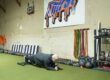
Watch the video below on how to maximize this exercise.
What Makes the Ab Fallout Different From Crunches
To understand why the ab fallout is worth your time, you have to understand what your core is actually designed to do. The muscles of your trunk — the rectus abdominis, the internal and external obliques, and the deep transverse abdominis — function primarily as stabilizers. Their most important role is to keep your spine in a safe, neutral position while resisting forces that try to pull it out of alignment.
One of the biggest of those forces is extension: the tendency for your lower back to arch and your ribcage to flare when load or gravity acts on your body. Anti-extension training teaches the anterior core to fight that arch and keep everything locked in place. This is the quality that carries over directly to athletic performance and to heavy lifting, where a leaky, unstable trunk can cost you power and expose your lower back to injury.
The glute ham roller ab fallout is a rollout-style, anti-extension movement. As you reach the roller away from your body, gravity increases the demand on your abdominals to keep your spine from collapsing into extension. Instead of shortening the muscles like a crunch, you’re loading them in a long, lengthened position and forcing them to hold you together. That distinction is what makes it such a powerful builder of usable core strength.
Equipment You’ll Need
The beauty of this exercise is its simplicity. You need a glute ham roller and enough open floor space to fully extend your body forward. Most rollers come with a handle option that you can grip, which I’d strongly recommend using — it keeps your wrists in a comfortable, neutral position and gives you better control through the movement. If your particular model doesn’t have handles, you can simply place your hands on the middle of the roller. The exact setup will depend on the brand and style you own, but either approach works.
If you don’t have a dedicated roller yet, the same movement pattern can be performed with an ab wheel or even a loaded barbell, though the roller offers a smooth, controlled glide that many people find easier to manage. Whatever tool you use, the mechanics and coaching points stay the same.
The Muscles Worked
The primary driver of the ab fallout is the anterior core — the muscles running along the front of your trunk that resist extension of the spine. The rectus abdominis (the “six-pack” muscle) works hard to keep your ribcage and pelvis connected as you lengthen out. The obliques stabilize against rotation and side-bending, and the deep transverse abdominis acts like an internal weight belt, cinching down to protect the spine.
You’ll also feel contributions from the lats and serratus anterior as they help control the arms and shoulders through the range of motion, along with the hip flexors and glutes working to keep your pelvis in the right position. This is part of what makes the ab fallout so efficient: it trains the core as an integrated system rather than isolating a single muscle, which is much closer to how your body actually operates under real demands.
How to Perform the Glute Ham Roller Ab Fallout, Step by Step
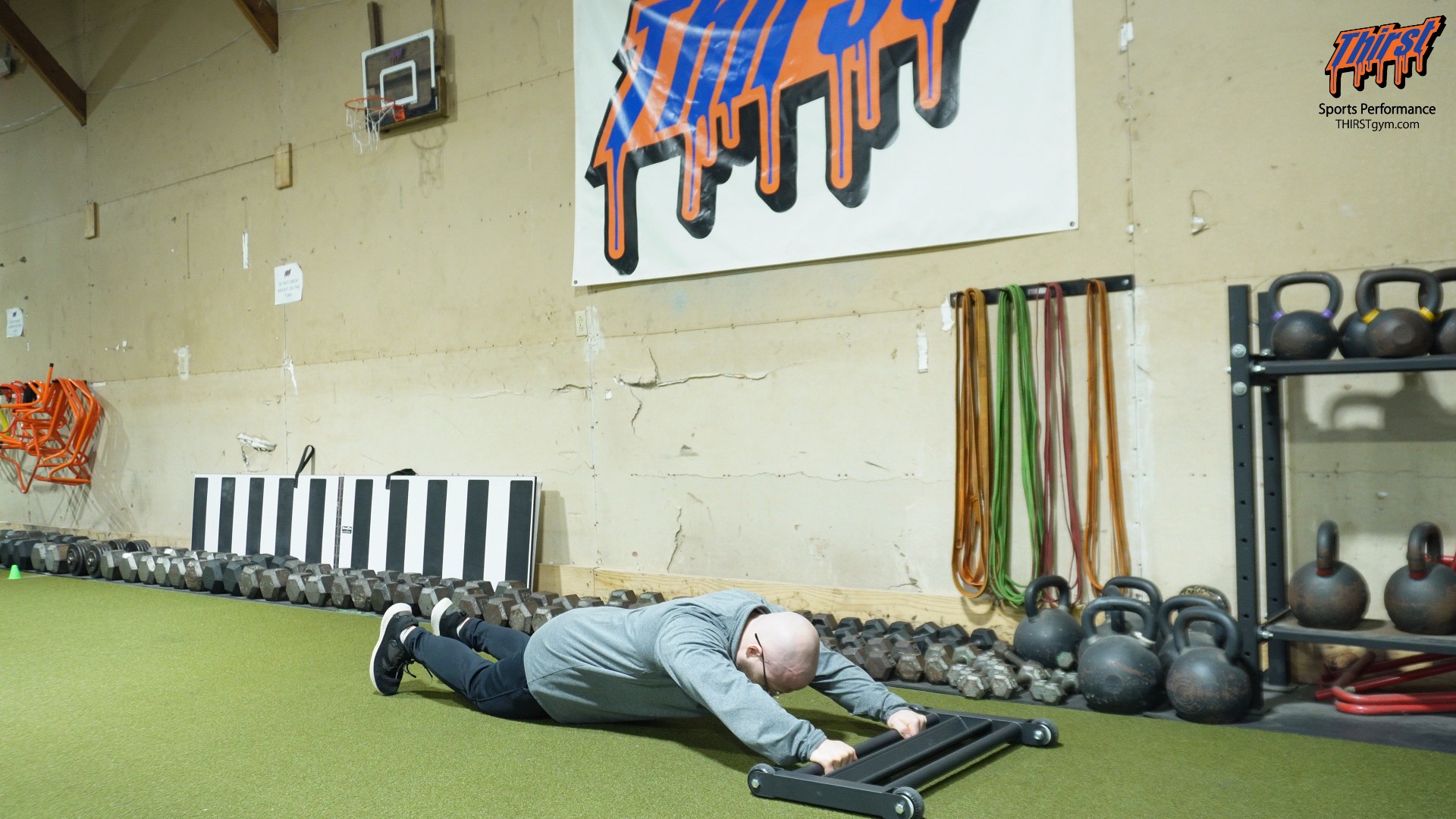
Start from a kneeling position on the floor with the roller in front of you. Set your hands directly underneath your shoulders — either gripping the handles or resting on the middle of the roller — and let your torso bend slightly forward over it.
Here’s the single most important setup cue, and it’s the one detail that separates a great rep from a wasted one: before you move anywhere, bring your hips forward so you settle into an almost plank-like position. You’ll know you’ve found the right spot when you feel your abdominals switch on and engage. Think of driving your belt buckle up toward your face — that mental image keeps your pelvis tucked and your ribs stacked over your hips exactly where they need to be.
From that braced position, reach the roller out in front of you as far as you can while keeping your spine long and neutral. The goal is to achieve a big, lengthened position without allowing your lower back to arch. Extend to the limit of what you can control, then drive back to the starting position by pulling everything back in with your core. Reach out long, come back strong, and repeat. Every rep should be a deliberate battle between reaching for maximum length and maintaining a rock-solid, stacked trunk.
The Most Common Mistakes That Sabotage Your Results
The ab fallout looks simple, but it’s easy to turn it into a completely different (and far less effective) exercise without realizing it. These are the errors I see most often.
Letting the Hips Hinge Backward
This is the big one, and it plagues nearly every rollout and ab wheel variation. Instead of keeping the hips forward and the trunk stacked, people leave their butt sticking out behind them and simply move their arms back and forth. You’ll feel a little something in the abs, but you’re largely missing the point of the movement — what you’re really doing is a lat exercise dressed up as a core drill. Keep the hips forward and the plank position intact throughout.
Arching the Lower Back
The second major fault happens as you extend out: the lower back sinks, the ribcage flares, and you lose the connection between your ribs and your pelvis. Once that stack breaks, the load shifts off your abs and dumps directly into your lumbar spine. Not only does this reduce the training effect, it’s the exact position you want to avoid for long-term back health. If you can’t reach out without arching, you’ve simply hit the end of your usable range for now — shorten the range and build from there.
Not Yet Having the Core Strength
Sometimes the issue isn’t technique at all; it’s that you don’t yet have the abdominal strength to control the full movement. That’s completely fine. This isn’t a reason to abandon the exercise — it’s a reason to regress it, build a foundation, and progress over time. Everyone starts somewhere.
How to Program the Ab Fallout
There are a couple of effective ways to work the ab fallout into your training. The first is to assign a specific rep range. I usually like to start people around six to eight reps and build them up over time to somewhere in the ten-to-fifteen range. The second approach is to simply perform as many quality repetitions as you can. If you’re consistently living in that target rep range, keep chasing a few more clean reps each session.
For sets, most people do well with anywhere from two to four working sets. The exact prescription depends heavily on the individual — their experience, their current core strength, and what else is in their program — but the majority of trainees will land somewhere in that six-to-fifteen rep, two-to-four set window when I program it for them.
I typically place the ab fallout toward the end of a training session as a finisher, once the heavier compound work is done. One thing to be aware of: because this exercise is so eccentric-heavy — meaning your muscles are under tension while lengthening — it can leave your abdominals genuinely sore, especially the first few times you do it. That soreness is nothing to worry about and doesn’t mean you did anything wrong. Just don’t be surprised if your midsection is talking to you for a day or two after your first couple of sessions.
Progressions and Regressions
One of the reasons the ab fallout is so useful across a wide range of people is that it scales beautifully in both directions.
To make it easier, shorten your range of motion so you’re only reaching out as far as you can control with a perfectly stacked spine, and gradually extend that range as you get stronger. Elevating your hands onto a bench or an incline reduces the load and is another great way to build into the full version. Plain kneeling plank holds are also a solid starting point for building the baseline stability the movement requires.
To make it harder, slow down the tempo so your muscles spend more time under tension on the way out, which dramatically increases the challenge. You can also add weight to the roller so you’re forced to pull more resistance back into the starting position. For advanced trainees, the ultimate progression is moving from your knees to your feet — but be honest with yourself here. Going to the feet is a big jump in difficulty, and the vast majority of people should stay on their knees and master that version first. There’s no prize for skipping steps.
Who Should Be Doing the Ab Fallout
This exercise earns its keep for a remarkably broad range of athletes and everyday trainees.
For wrestlers and combat sport athletes, the ability to brace and resist extension is non-negotiable. Scrambling, defending, and fighting for position all demand a trunk that stays rigid under chaotic, unpredictable forces — and anti-extension training builds exactly that quality.
For powerlifters and strength athletes, a stable, well-braced core transfers directly to the squat, bench press, and deadlift. Learning to keep the ribcage and pelvis connected under load protects the lower back and helps you express more force through the bar.
For general fitness clients, the ab fallout builds the kind of functional core strength that supports better posture, a healthier back, and more capable everyday movement — without a single crunch.
Youth athletes can benefit as well, provided they start with appropriate regressions and prioritize clean technique over reaching for a long, ambitious range they can’t yet control. The same principle applies to older adults, for whom a shortened range, elevated hands, or simple plank holds can serve as an excellent, back-friendly entry point into anti-extension training.
Final Thoughts
The glute ham roller ab fallout is a deceptively simple exercise that delivers serious results when it’s done well. Keep your hips forward, maintain that stacked, plank-like position from your ribcage through your pelvis, reach out as far as you can control without arching, and pull everything back in with your core. Nail those fundamentals, program it intelligently, and progress patiently, and you’ll build a stronger, more stable, and more athletic midsection that carries over to everything you do — on the mat, under the bar, and in daily life.