
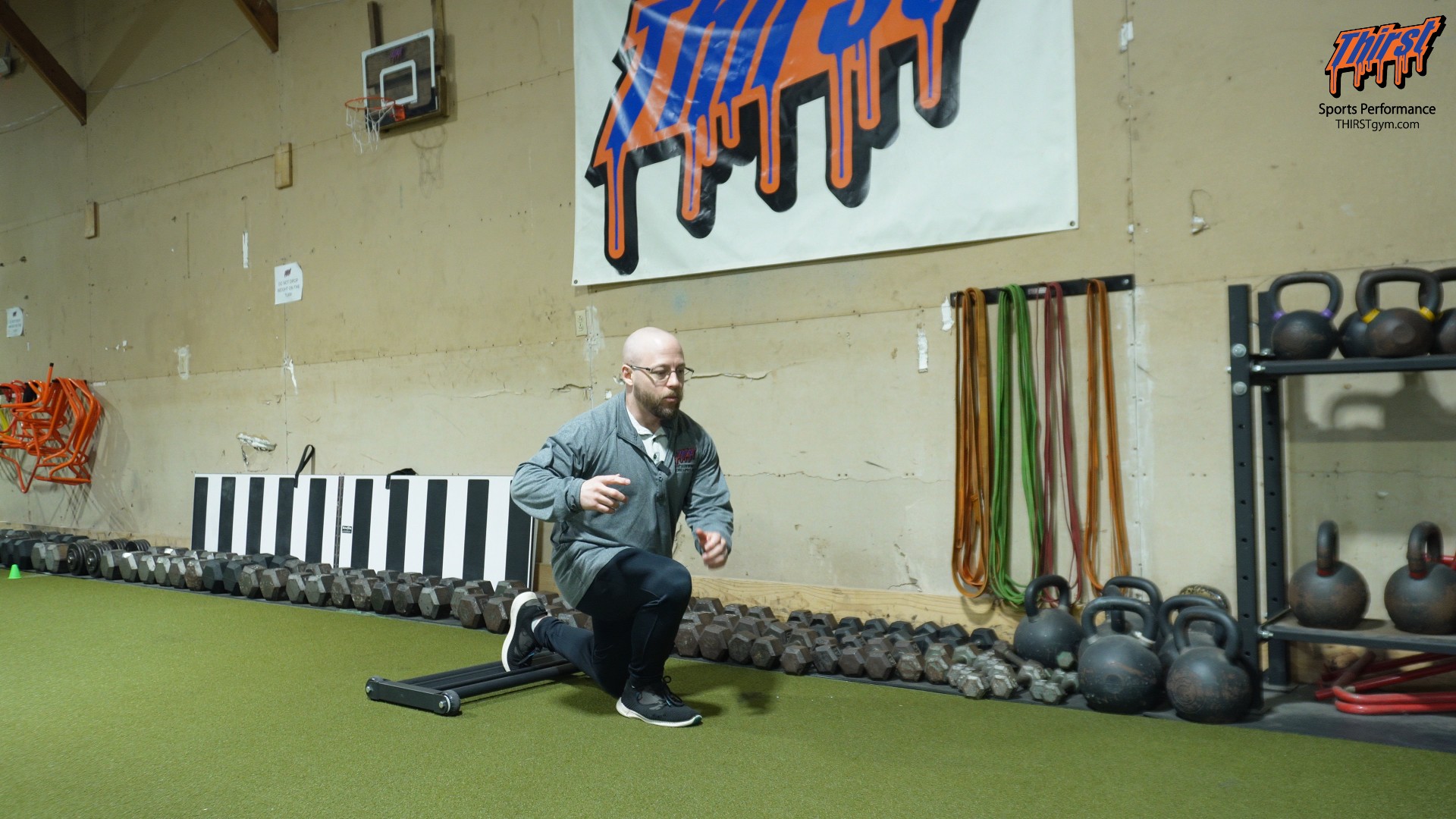
The Glute Ham Roller Reverse Lunge: A Smarter Way to Build Single-Leg Strength and Stability
If you’ve been looking for a reverse lunge variation that challenges balance, builds real single-leg strength, and goes easier on your joints than a lot of the alternatives, the glute ham roller reverse lunge deserves a spot in your program. It’s a deceptively simple movement that delivers a big return: better hip stability, stronger quads and glutes, and a training effect that carries over directly to sport and everyday life. Below, we’ll break down exactly how to perform it, which muscles it targets, the mistakes to avoid, and how to program it for everyone from competitive athletes to general fitness clients.
Watch the video below on how to maximize this exercise.
What Is the Glute Ham Roller Reverse Lunge?
The glute ham roller reverse lunge is a unilateral (single-leg) lower body exercise that uses a glute ham roller to support your back foot while your front leg does the majority of the work. Instead of stepping backward into empty space the way you would with a traditional reverse lunge, your trailing foot rests in the roller and slides behind you as you descend. Your front leg then drives you back up to the starting position.
That small change makes a meaningful difference. The roller gives your rear foot a stable, supportive point of contact, which lets you load the front leg with confidence while still demanding balance and control through the hips and torso. It’s a movement that sits in a sweet spot between a fully supported split squat and a completely free-standing lunge, giving you many of the stability benefits of the harder variations without leaving you fighting for balance the entire set.
Equipment You’ll Need
To perform this exercise, you’ll need a quality glute ham roller and a bit of open floor space. Most rollers include a built-in rivet or hook in the middle section, and that feature matters here. That recessed area is exactly where your back foot goes. It gives your toe a defined place to sit so the roller doesn’t shoot out from under you the moment you start moving, and it makes the whole setup far more secure than trying to balance on a smooth surface.
If you’re in the market for durable equipment that holds up to repeated use, EliteFTS carries roller options and a wide range of strength training gear worth checking out.
Beyond the roller, the only other requirement is space to slide your trailing leg back comfortably behind you. A few feet of clearance is plenty. If you want to add load, you’ll also want a dumbbell or a pair of dumbbells, which we’ll cover in the technique and loading sections below.
Muscles Worked
The glute ham roller reverse lunge is a compound lower body movement, which means it recruits several major muscle groups at once rather than isolating a single area.
The primary movers are the quadriceps of the front leg, which handle much of the work as you lower under control and drive back up to the top. The glutes, particularly the gluteus maximus, are heavily involved in extending the hip and locking you out at the top of each rep. The hamstrings and adductors contribute as stabilizers and assist in controlling the descent and driving out of the bottom position.
Just as important are the muscles you might not immediately think of. Because this is a single-leg exercise performed on a moving implement, your hip stabilizers, including the smaller glute muscles like the gluteus medius, are constantly working to keep your pelvis level and your knee tracking properly. Your core and spinal stabilizers stay engaged throughout to keep your torso upright, especially when you add load. That combination of prime movers and stabilizers is exactly what makes single-leg training so valuable and so effective for building athletic, resilient strength.
How to Perform the Glute Ham Roller Reverse Lunge
Setting up correctly is the key to getting the most out of this movement. Here’s the step-by-step technique.
Setting Up Your Position
Start by placing the glute ham roller on the floor behind you. Identify which leg is going to do the work; that leg stays planted in front of the roller. Your other leg, the one that won’t be driving the movement, goes into the hook or rivet area in the middle of the roller. Rest the toe of that trailing foot into that recessed spot for support.
Once you’re set up, you’ll notice you’re essentially in a kickstand position before the exercise even begins. Your front foot is flat and loaded, and your back toe is lightly resting in the roller. This is your starting point for every rep.
Executing the Reverse Lunge
From that kickstand stance, perform a reverse lunge. Rather than picking your foot up and stepping backward, you’re going to slide the roller behind you, letting your trailing leg extend as the roller rolls away. As it slides back, your front leg bends and you descend into the bottom of the lunge.
To come back up, drive through your front foot. That front leg is the engine of the whole movement; use it to pull yourself forward and stand back up as the roller returns toward its starting position. Focus on locking your hip out fully at the top so you finish each rep in a strong, extended position.
Adding Load
You can perform this movement with body weight alone, and that’s a perfectly good place to start. When you’re ready to add resistance, you have a couple of straightforward options. You can hold a single dumbbell or kettlebell in the goblet position at your chest, which is great for keeping the torso upright and reinforcing good posture. Alternatively, you can hold a dumbbell in each hand down by your sides for a more loaded, traditional feel. Both work well, so choose based on what you have available and what feels best for your goals.
Common Mistakes and How to Fix Them
Most people pick this exercise up quickly, but a few points are worth keeping in mind.
The first thing to understand is a small quirk of the movement rather than a true error: you won’t be able to bring your trailing leg all the way up the way you would in a free reverse lunge, and you’ll feel your back foot make contact as you return to the top. This is completely normal and nothing to worry about. Despite that limited range on the back leg, you’ll still achieve full hip extension and a strong lockout at the top, which is what actually matters. Don’t fight it or try to force extra range; just let the movement flow naturally.
A more common genuine mistake is staying up on your tiptoes on the roller foot the entire time because you’re afraid to trust the equipment. Many people feel wobbly at first and assume they have to keep almost all their weight off the roller. In reality, you can place a meaningful amount of weight onto that trailing foot. The roller provides more support than most people expect. Once you realize you can actually settle into it, the exercise feels far more stable and you can focus on driving with your front leg instead of white-knuckling your balance.
Finally, watch your torso and knee position. Keep your chest tall, brace your core, and make sure your front knee tracks in line with your foot rather than caving inward. These are the same fundamentals that apply to any quality lunge, and they hold true here as well.
Why This Exercise Belongs in Your Program
The glute ham roller reverse lunge earns its place because it challenges your stability in a productive way, just as most lunges do, while offering a bit more support and a friendlier feel than many free-standing variations. That balance of challenge and support makes it accessible to a wide range of trainees without sacrificing the training effect that makes single-leg work so worthwhile.
Single-leg exercises like this one help address strength imbalances between your left and right sides, which is something bilateral movements like the back squat can mask. They build the kind of hip and knee stability that protects joints and improves movement quality. And because so much of sport and daily life happens on one leg at a time, unilateral training has strong carryover into real-world performance.
Programming the Glute Ham Roller Reverse Lunge
How you program this movement depends on your goals, but here’s the general framework that works well for most people, including the athletes and clients we train.
A solid default is three to four sets of about six to ten reps per leg. That rep range builds strength and quality single-leg control without piling on excessive fatigue, and it’s a reliable starting point whether you’re using it as a main lower body movement or an accessory.
From there, you have room to adjust. If you want to build strength and really get after it, you can load this movement much heavier and keep the reps on the lower end of that range. If your goal is more volume and conditioning, you can push into higher repetitions and crank out the work. The exercise is flexible enough to serve both ends of that spectrum, so let your training objective guide the load and rep scheme.
Programming for Athletes
For competitive athletes, we like to keep the reps a little lower, especially during periods when they’re doing a lot of sport-specific work. Wrestlers, combat sports athletes, and other competitors are already accumulating significant training stress from practice, sparring, and events. Keeping the reps on the lower end allows them to get the strength and stability benefits of the exercise while still being able to recover and perform in their sport. The goal is always to support their athletic development, not to bury them in the weight room at the expense of their competition readiness.
This principle applies broadly across the athletes we work with, and it’s a big part of why single-leg movements that build stability without excessive fatigue are so valuable in an athletic strength and conditioning program.
Who Is This Exercise For?
One of the best things about the glute ham roller reverse lunge is how widely applicable it is. It works well for competitive athletes in wrestling, combat sports, and other field and court sports who need strong, stable single-leg mechanics. It’s a great fit for powerlifters and general strength trainees looking for an accessory movement that builds the quads and glutes while improving stability. And it’s approachable enough for general fitness clients, youth athletes, and older adults who benefit from single-leg strength and balance work but may find fully free-standing lunges intimidating at first.
Because the roller provides that extra bit of support, you can regress the exercise by keeping the load light and focusing on control, or progress it by adding significant load and pushing the intensity. That scalability is what makes it a genuinely useful tool across a wide range of ability levels and training goals.
Final Thoughts
The glute ham roller reverse lunge is a straightforward, effective addition to any lower body program. It builds single-leg strength in the quads and glutes, challenges hip and core stability, and offers a supportive, joint-friendly alternative to some of the more demanding lunge variations, all with minimal equipment. Set up in that kickstand position, trust the roller to support you, drive hard through your front leg, and lock out your hip at the top, and you’ve got a movement that pays real dividends whether you’re chasing sport performance or simply building stronger, more capable legs.