
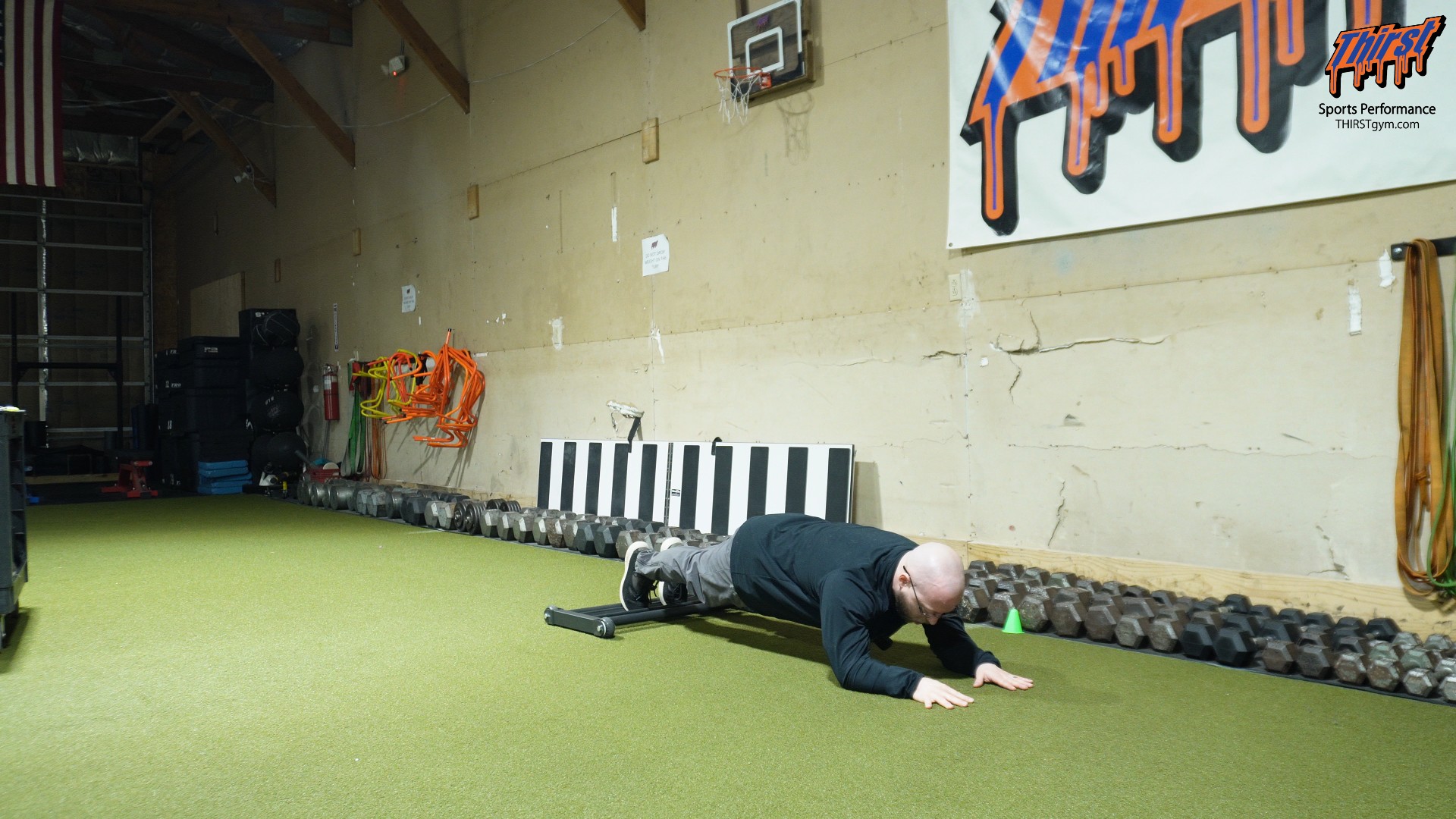
The Glute Ham Roller Buzzsaw Plank: A Smarter Anti-Extension Core Exercise for Athletes
Core training gets watered down fast. Somewhere between endless crunches and holding a static plank until your mind goes numb, a lot of athletes stop actually training the trunk the way it functions in sport. The job of the anterior core isn’t to flex your spine over and over — it’s to resist forces that try to pull your spine into extension while your limbs move. That’s the entire point of anti-extension work, and the glute ham roller buzzsaw plank is one of the cleanest, most scalable ways to train it.
If you have access to a glute ham developer with a roller pad, or any similar rolling apparatus, this variation belongs in your programming toolbox. It takes the standard buzzsaw plank and gives you a smooth, controlled track to move along, which makes the exercise both easier to teach and easier to progress. Here’s how to coach it, program it, and level it up for everyone from raw beginners to advanced athletes.
Watch the video below on how to maximize this exercise.
What Is the Buzzsaw Plank?
The buzzsaw plank is a dynamic evolution of the traditional forearm plank. Instead of holding one fixed position, you rock your body forward and backward over your elbows in a small, deliberate range of motion. That subtle shift is what earns it the “buzzsaw” name — the motion looks like the back-and-forth cutting action of a saw blade.
The reason this small movement matters is that it dramatically increases the anti-extension demand on your abdominals. In a static plank, once you find a stable position, your core can settle in and coast. The moment you start moving your center of mass forward past your elbows, gravity starts trying to pull your hips toward the floor and hyperextend your lumbar spine. Your abs, and especially your deep trunk stabilizers, have to fire harder to keep your torso rigid and your spine neutral. You’re no longer just holding a position — you’re actively resisting a moving load throughout a range.
Using a glute ham roller as the anchor point for your feet changes the exercise in a useful way. The roller gives your lower body a stable but slightly mobile base, and the pad’s surface (mine has rivets on it, though yours may be smooth — either works) lets you settle your feet in and drive from a consistent platform. The result is a version of the buzzsaw plank that’s controlled, repeatable, and easy to load later.
How to Perform the Glute Ham Roller Buzzsaw Plank
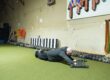
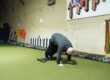
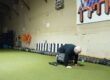
Set the glute ham roller on the floor and place your feet up on the roller pad. From there, walk yourself out into a standard forearm plank position with your elbows on the ground and your body forming one long line from your heels to the crown of your head.
Before you move an inch, own the plank itself. This is where most of the value lives, so take the position seriously. Your hips should be relatively flat — not sagging toward the floor, and not piked up high in the air. A sagging hip means you’ve already given up the neutral spine you’re trying to protect, and a high hip turns the drill into a rest position instead of a challenge. Think about one straight line and hold it.
Regarding hand position, coaching the plank with the palms flat on the floor rather than clasped is a personal preference worth trying. Pressing the palms down tends to increase serratus anterior recruitment and encourages the shoulder blades to spread and wrap around the rib cage, which stacks the shoulder more securely and makes the abdominals work a little harder to keep everything tied together. It’s not mandatory, but for a lot of athletes it produces a more connected, more demanding position.
Once you’re set, the movement itself is simple. Push yourself backward, letting your body travel back until you feel yourself getting long and stretched through the trunk. Then reverse it and drive forward, bringing your shoulders back over your elbow position while reaching long through your arms. Move slowly and stay in control the whole time. This is not a big motion — it’s a short, contained range — but it’s more than enough to light up the abdominals as they work overtime to maintain position against the shifting load. One full trip back and forward counts as a single repetition.
Common Mistakes to Watch For
The most frequent breakdown is losing the neutral spine as fatigue sets in. As the abs tire, the hips start to dip and the lower back arches to compensate. The second that happens, you’ve stopped training anti-extension and started grinding on your lumbar spine. Cut the set the moment form breaks — quality reps are the entire point of this drill, and there’s no benefit to accumulating sloppy ones.
The other common error is turning the buzzsaw into a big, exaggerated rocking motion in an effort to feel like you’re doing more. Bigger is not better here. A small, controlled range keeps constant tension on the trunk and keeps you honest. If you find yourself flinging back and forth, slow everything down and shrink the range until you can feel the abs doing the work on every inch of the motion.
Finally, don’t rush the reps. The slower and more deliberate the tempo, the greater the time under tension and the higher the stability demand. Speed hides weakness; slow tempo exposes it and builds it.
Programming the Glute Ham Roller Buzzsaw Plank
There are a few clean ways to work this into a training block, and the right choice depends on the athlete in front of you.
The simplest approach is to program it for time. Set a duration and have the athlete perform slow, controlled buzzsaw reps for the full window — 10, 15, or 20 seconds to start, and 30 seconds for someone who’s genuinely tough and well-conditioned in the trunk. Timed sets are great for beginners because they take the pressure off counting and let the athlete focus entirely on holding position.
The other approach is standard sets and reps, counting each full back-and-forward cycle as one repetition. A good starting point for most athletes is the six-to-eight rep range, which keeps the volume low enough to protect form while the movement pattern is still new. From there, the goal is to build over time toward roughly twelve to fifteen total repetitions per set as trunk stability and endurance improve. That rep progression gives you a simple, trackable path to measurable improvement.
Once an athlete can comfortably handle the higher rep ranges with clean technique, it’s time to add load. The two easiest ways to do this are placing a weight plate across the athlete’s back, or loading a plate onto the apparatus itself so there’s more total mass to move through the range. Both options increase the demand on trunk stability and force the core to control a heavier system. External loading is what keeps this exercise relevant for advanced and strong athletes long after bodyweight versions stop being challenging.
Who Should Use This Exercise
The beauty of the glute ham roller buzzsaw plank is how widely it applies. Because it scales so easily — from short timed holds all the way up to loaded, higher-rep sets — it works for a broad range of athletes at very different levels within the same training environment.
For combat sports athletes like wrestlers and grapplers, trunk stability under shifting loads is non-negotiable, and anti-extension strength directly supports the bracing and posture required on the mat. For powerlifters, a rock-solid anterior core translates to better bracing under heavy squats and deadlifts. General fitness clients benefit from the joint-friendly, low-skill entry point, and the timed version is an easy on-ramp for beginners. And because you can load it, it stays challenging enough for well-trained athletes who need more than a bodyweight hold.
A Reliable Go-To in Your Anti-Extension Toolbox
If you have access to a glute ham developer, the glute ham roller buzzsaw plank deserves a spot near the top of your buzzsaw plank options. It’s simple to teach, easy to scale, and genuinely effective at building the kind of trunk stability that carries over to sport. It’s the kind of exercise you can hand to almost any athlete and trust to deliver results.
If you don’t have a glute ham roller, don’t worry — the TRX buzzsaw plank is another excellent variation that trains the same quality using suspension straps, and it’s a strong alternative when the roller isn’t available. But when you do have the apparatus on hand, this version is hard to beat.