
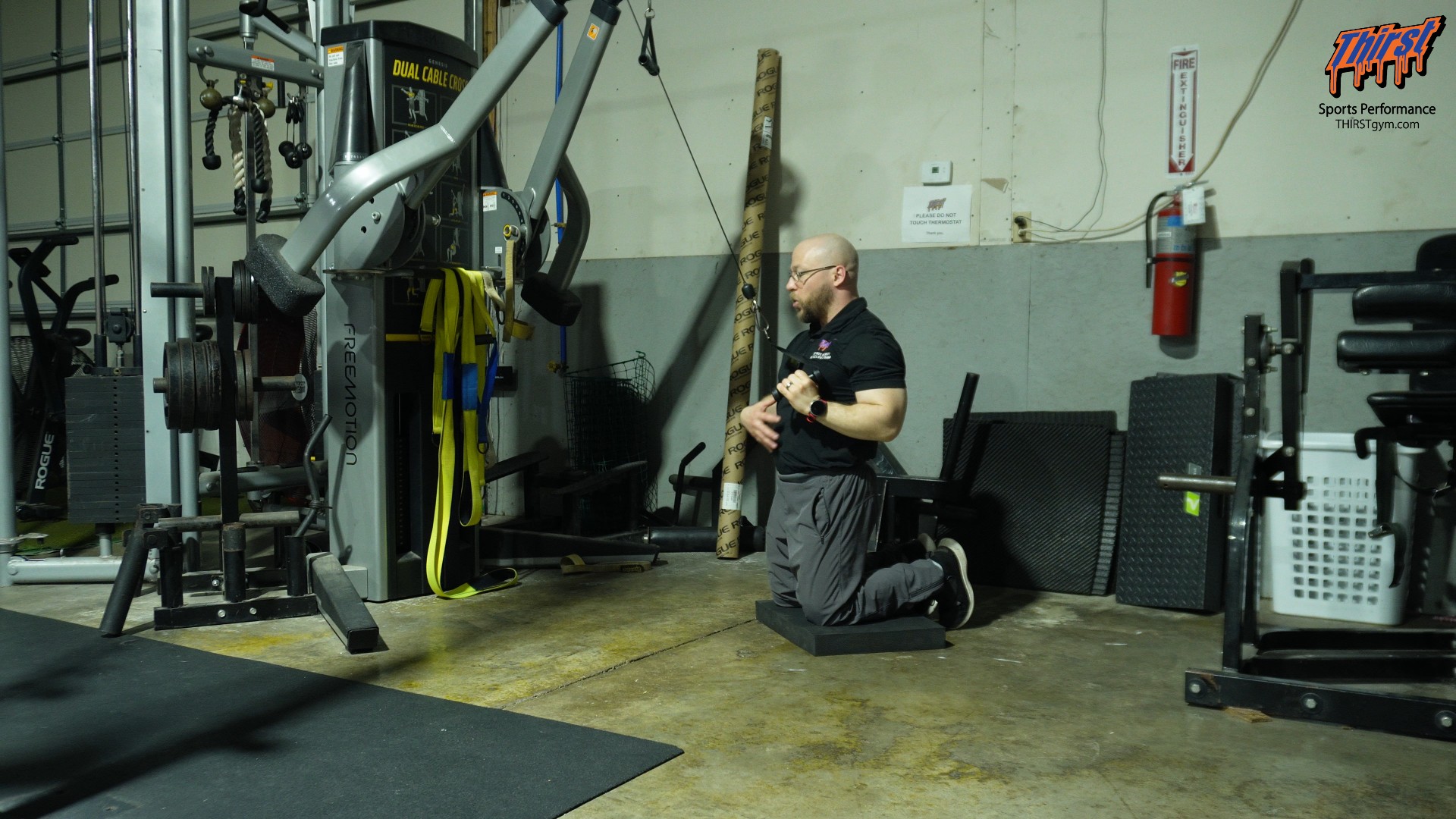
Tall Kneeling Single-Arm High Cable Row: Technique, Benefits, and Programming
Most back exercises let you cheat. Sit on a lat pulldown with a heavy stack and you can lean back, hitch through the hips, and pull with momentum. The tall kneeling single-arm high cable row takes those options away. By kneeling tall, working one arm at a time, and pulling from a high angle, you turn a simple lat exercise into a full-body movement that trains your upper back, your anti-rotation core strength, and your glutes and hamstrings together.
At THIRST Gym in Terre Haute, Indiana, we use this exercise with athletes and general fitness clients who need to learn how to own their position under load. It fits into almost any program, it’s easy on the shoulders, and it shows you right away who can hold a stable trunk and who can’t. Here’s how to set it up, how to perform it, and how to program it.
Watch the video below on how to maximize this exercise.
What Is the Tall Kneeling Single-Arm High Cable Row?
The tall kneeling single-arm high cable row is a unilateral pulling exercise done on a cable machine from a tall kneeling position. Both knees are on the ground, your hips are fully extended, and you pull a single handle from above and in front of you down toward your side.
The pulling angle sits between a vertical pull like the lat pulldown and a horizontal pull like the seated cable row. That high-to-low path makes it a good modified single-arm lat pulldown. The big difference from a standard pulldown is the base of support. You aren’t locked into a seat with a thigh pad holding you in place. Your lower body and trunk have to create that stability on their own, and that’s where most of the value comes from.
Muscles Worked
The main muscle here is the latissimus dorsi, which pulls the upper arm down and back toward your side. It gets help from the teres major, the rhomboids, the middle and lower trapezius, the rear delts, and the biceps and forearm flexors that hold the handle.
What sets this exercise apart is everything working beneath the arm. Because you’re pulling with one arm, the cable tries to rotate your torso toward the working side. Your obliques, transverse abdominis, and the rest of your deep core have to resist that rotation, so this is an anti-rotation exercise as much as a back exercise. Your glutes and hamstrings stay switched on to hold your hips extended. Your rectus abdominis works to keep your ribs down and stop your lower back from arching. You get a real full-body training effect from one movement.
Equipment and Setup
You need a cable machine with an adjustable pulley and a standard single handle (D-handle) attachment. Set the pulley high enough that the cable starts above your head once you’re kneeling. You can also kneel on a balance pad or folded mat for comfort. It’s optional, but most people will enjoy a set of 12 a lot more with something under their knees.
[OPTIONAL ELITEFTS MENTION — keep or remove] If you’re outfitting a home or garage gym, EliteFTS carries cable attachments and training pads that hold up well to this kind of daily use.
Position yourself so the cable comes toward you at an angle rather than straight down from overhead. The further you kneel from the machine, the more the pull shifts toward a row. The closer you kneel, the more it becomes a pulldown. There’s no single correct angle. Adjust it based on what you want to emphasize and what feels best for your shoulder. A moderate diagonal, roughly 30 to 45 degrees in front of vertical, is a good starting point for most people.
How to Perform the Tall Kneeling Single-Arm High Cable Row
Get Into the Tall Kneeling Position
Grab the handle with one hand and kneel down facing the machine. Put both knees on the pad and dig your toes into the ground so the balls of your feet give you something to push against. Drive your hips forward until they’re fully extended and stacked over your knees. You should feel your glutes and hamstrings contract. This isn’t a relaxed kneel. Your hips should feel locked in.
Next, bring your ribs down. Many people who kneel tall end up arching their lower back and flaring their ribcage. Pull your ribs down toward your pelvis until you feel your abs engage. If you’re set up well, you’ll feel your abs working before the first rep. That’s how you know you’re stacked.
Start From a Long Arm
With the cable out in front of you at your chosen angle, let the working arm reach fully. Let the shoulder blade slide up and forward around your ribcage so the lat is on stretch. This long starting position is where a lot of the benefit comes from, so don’t cut it short.
Drive the Elbow Down and Back
Keep your glutes, hamstrings, and trunk tense and pull by driving your elbow down and back toward your hip. Think of your hand as a hook and your elbow as what’s doing the work. Keep pulling until your elbow is at or slightly behind your torso. The rest of your body shouldn’t move. Your hips stay forward, your ribs stay down, and your shoulders stay square to the machine.
Return Under Control
Let the weight pull your arm back to the start position slowly. Go all the way back to a long arm and let the shoulder blade move with it before starting the next rep. Finish all reps on one side, then switch.
Coaching Cues That Clean It Up
A few simple cues fix most technique problems. “Squeeze the glutes, ribs down” sets the position before the first rep and resets it when things start to drift. “Get long” reminds people to use the full stretch at the top. “Elbow to your back pocket” gives the pull a clear direction and keeps the lat doing the work instead of the biceps. “Don’t let the cable turn you” makes the anti-rotation part something the lifter is aiming for rather than something that just happens.
When coaching this in a group, look at the belt line. If the hips shift back or rotate, the lower body has stopped doing its job, and the weight is probably too heavy.
Common Mistakes
Sitting Back Into the Hips
When the glutes switch off, the hips move back toward the heels and the lifter ends up in a half-seated position. This takes away the posterior chain work and usually brings in a lower-back arch to make up for it. Push the hips forward again and lighten the load if you need to.
Arching the Lower Back
Too much lumbar extension and anterior pelvic tilt is the most common fault, especially in athletes who already stand that way. The ribs flare, the lower back takes the stress, and the core stops contributing. The ribs-down cue fixes this. This exercise is also one of the best ways to teach the correct position, which we’ll cover below.
Rotating Toward the Pull
If your chest turns toward the working side as you pull, you’ve given up the anti-rotation training. Your shoulders and hips should stay facing forward the whole set.
Cutting the Range of Motion Short
Stopping the arm halfway up on each rep means missing the stretched position where the lat works hardest and where the shoulder blade gets to move freely. A slightly lighter weight through a full range will do more for you than a heavy weight through a partial one.
Going Too Heavy Too Soon
This exercise is limited by your ability to hold the tall kneeling position, not by how strong your back is. It isn’t the place to max out on the cable stack, especially at first. Once the load is more than your trunk and hips can control, the exercise becomes a sloppy pulldown and you lose what makes it useful.
Benefits of the Tall Kneeling Single-Arm High Cable Row
Full-Body Training From One Exercise
Most accessory lifts target one area. This one trains your lats and upper back, your anti-rotation core strength, and your glutes and hamstrings together, in a way that matches how the body works in sport. When your training time is limited, that’s valuable.
Teaches Glute and Hamstring Engagement
Many clients and athletes have trouble feeling their glutes and hamstrings. Tall kneeling makes that easier. When the knees are on the ground and the hips have to stay extended, the only way to hold the position is to use the posterior chain. It’s a great teaching tool, and the positional awareness transfers to squats, hinges, and athletic movements.
Addresses Excessive Lumbar Extension and Anterior Pelvic Tilt
Athletes who live in an arched, anteriorly tilted position often keep that pattern in every lift. The tall kneeling high cable row lets you correct it while still training hard. The athlete has to control their pelvis and ribcage to do the exercise correctly, so they practice a better position under real load, not just in a corrective drill on the floor.
Shoulder-Friendly Pulling
Because the cable comes from in front rather than straight overhead, you don’t need full overhead shoulder mobility to do this well. The shoulder blade can move freely around the ribcage through the whole range, reaching up and forward at the top and rotating down and back as you pull. This natural scapular movement tends to feel much better than a fixed-bar pulldown for lifters with irritated shoulders, and it helps keep the shoulders healthy over time.
Unilateral Strength and Balance
Training one arm at a time shows left-to-right differences that bilateral lifts can hide. It also keeps the stronger side from making up for the weaker one, which matters for athletes in rotational and asymmetric sports.
Who Should Use This Exercise
Wrestlers and combat sports athletes get a lot from this exercise. It combines pulling strength with anti-rotation stability from a kneeling base, which is similar to how they use their bodies on the mat. Hand fighting, fighting for underhooks, and controlling an opponent from the knees all require pulling hard while keeping the trunk stable.
Powerlifters can use it as lat accessory work that supports a tight back on the bench and a solid upper back in the squat, without the stress on the shoulders that comes with heavy pulldowns late in a training block. Swimmers and overhead athletes benefit from the lat strength and the free scapular movement. General fitness clients and older adults get a back exercise that also builds trunk control and hip extension strength, as long as they can kneel comfortably with a pad. Youth athletes can learn how to brace and stack their body before they need to do it under heavier barbell loads.
Progressions and Regressions
If the tall kneeling position is too hard to hold at first, start with a seated single-arm cable pulldown so the athlete learns the pulling pattern without the stability demand. A two-arm tall kneeling high cable row with a rope or two handles is another good step, because it takes away the rotational pull while keeping the kneeling position.
Once the standard version is solid, make it harder by adding a two-second pause with the elbow at your side, slowing the lowering phase to three or four seconds, or gradually adding load while keeping perfect position. A half-kneeling version changes the challenge by narrowing your base and adding more hip-stability work. A standing split-stance version gets the athlete closer to how they’ll need to produce force in their sport.
Programming the Tall Kneeling Single-Arm High Cable Row
Do 2 to 4 sets of 8 to 12 reps per side. That range builds the lats and upper back, gives the core plenty of time under tension, and keeps the load where the athlete can hold a good position.
This exercise works best as an accessory after your main lift for the day. It pairs well with a pressing movement in a superset. For example, alternate it with a single-arm dumbbell bench press or a landmine press for a balanced push-pull pair. It also fits on lower-body days as a way to add upper-back volume without adding much fatigue.
Treat it as a skill before you treat it as a strength lift. Use it until your clients and athletes can reliably get into the right position and move well, then progress the load, change to a harder variation, or rotate to another pulling exercise. The goal isn’t to stay on it forever. The goal is to build the positioning and body awareness that carry over to everything else in the program.
Final Thoughts
The tall kneeling single-arm high cable row looks like a simple back exercise, but it asks for a lot more. It trains the lats, builds anti-rotation core strength, teaches the glutes and hamstrings to work, and gives the shoulders a comfortable way to pull. Choose a weight you can control, stay tall, get long at the top, and drive the elbow back.