
Forward Bounding: The Sprint Mechanics Drill That Builds Faster, Springier Athletes
If you want to run faster, most people assume the answer is simply to run more. But speed isn’t only about how hard you push — it’s about how you move while you’re pushing. The way your foot strikes the ground, how long it stays there, and how efficiently you convert force into forward motion all determine whether you’re a fast athlete or a merely willing one. Forward bounding is one of the simplest, most effective drills for cleaning up those mechanics, and it deserves a spot in almost any athlete’s warm-up or speed development program.
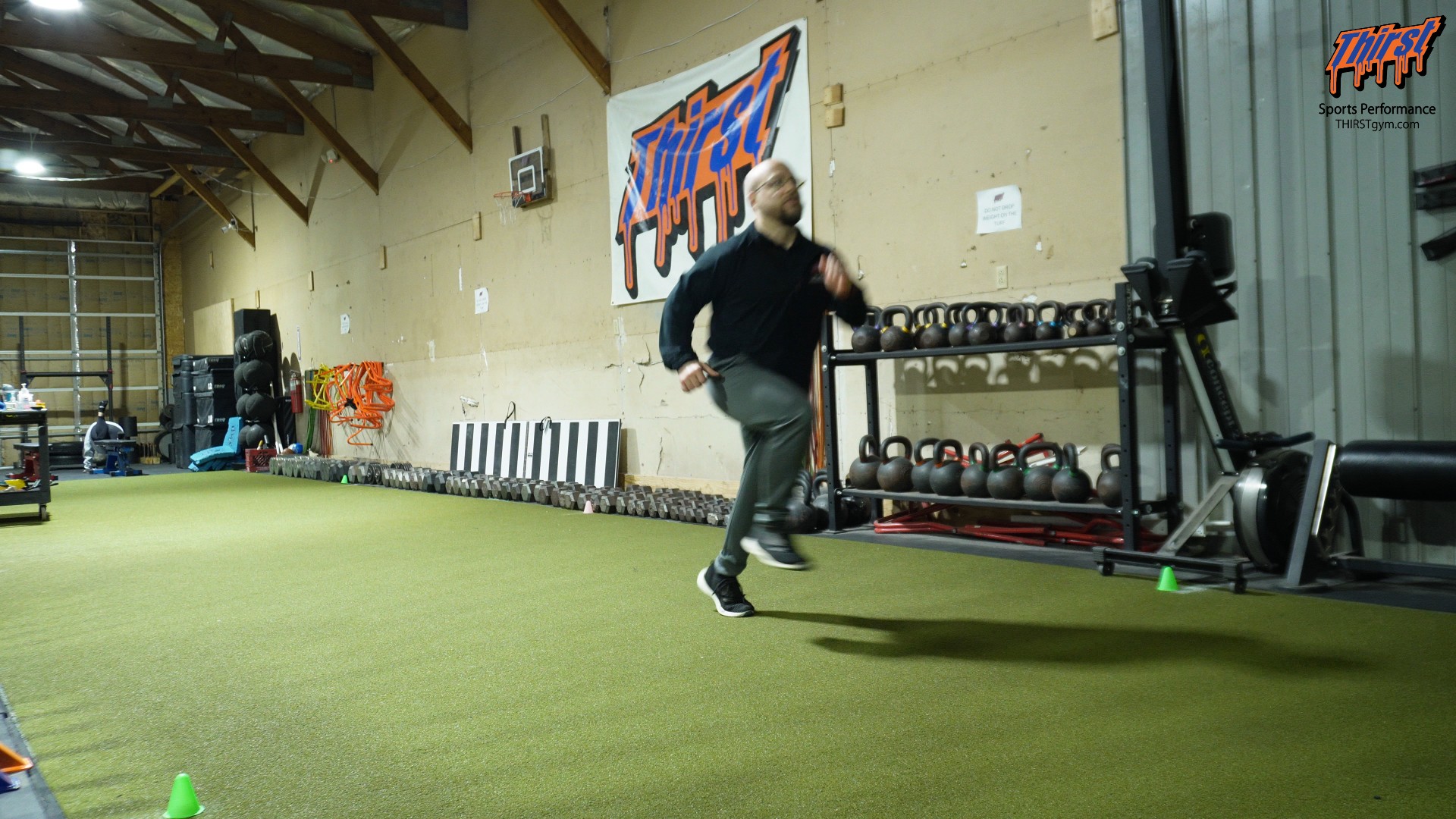
Forward bounding is exactly what it sounds like: instead of running normally, you exaggerate each stride into a powerful bound, driving off one leg and covering as much horizontal distance as you can before landing and immediately bounding off the other. It looks a little like slow-motion, oversized running, and that’s the point. By slowing the movement down and stretching out each stride, you force yourself to feel and reinforce the mechanics that make sprinting fast and efficient. This is a technique drill first and a conditioning tool second. Yes, it will make you more powerful and more athletic over time, but the primary purpose is teaching your body how to run correctly.
Watch the video below on how to maximize this exercise.
Why Forward Bounding Belongs in Your Training
Sprinting is a series of collisions. Every time your foot hits the ground, your body has to absorb that impact and redirect the energy forward — ideally in a fraction of a second. The athletes who do this best spend very little time on the ground per step. This is called ground contact time, and reducing it is one of the biggest separators between average and elite speed. The longer your foot lingers on the ground, the more momentum you bleed off and the slower your turnover becomes.
Forward bounding trains your body to minimize that ground contact time while maximizing the force you put into each step. When you bound, you’re teaching your legs to act like springs — loading quickly on contact and then rebounding immediately without collapsing or pausing. That “springy” quality comes largely from your Achilles tendons and the surrounding connective tissue, which store and release elastic energy with every stride. Bounding is one of the best ways to build the stiffness and reactive strength in those tissues, which is what allows fast athletes to bounce off the ground rather than sink into it.
There’s also a coordination benefit that’s easy to overlook. Bounding forces you to drive the knee up aggressively, extend the hip fully, and stay tall through your posture — all hallmarks of good sprint mechanics. Because the movement is exaggerated and deliberate, you get more reps of “good” motor patterns than you would just sprinting, where everything happens too fast to consciously correct. Over time, those patterns carry over into your actual running.
What You Need and How to Set Up
The beauty of forward bounding is that it requires almost nothing. You need a straight line and some open space to move through — that’s it. A stretch of turf, a track, an open field, or even a long stretch of flat pavement will all work perfectly. Twenty yards is plenty to get meaningful work in, though if you have access to 30, 40, or 50 yards, you can absolutely use it. Even a shorter runway of 15 to 20 yards is enough to reap the benefits, so don’t let limited space stop you.
Because bounding is a plyometric, lower-impact-forgiving surfaces like turf, grass, or a rubberized track are ideal, especially for younger athletes or anyone new to the drill. You want to be warmed up before you start — this isn’t something to do cold. A few minutes of easy jogging, some dynamic mobility, and a couple of build-up runs will get your tendons and muscles ready to handle the reactive demands. Forward bounding fits naturally at the end of a warm-up, before practices, before games, or as the opening piece of a dedicated speed session while you’re fresh.
How to Perform Forward Bounding
Start by jogging into the drill or beginning from a standstill, then transition into exaggerated, powerful strides. Rather than running normally, you’re going to take big, aggressive steps and bound off each leg, pushing yourself both forward and slightly upward with every push-off. Think about staying tall and running as “high” as you can through the movement — you don’t want to hunch or collapse forward at the waist.
The single most important cue is to stay on your toes. In normal running, your foot rolls through a fuller contact, but in bounding you want to strike and push off the balls of your feet, keeping your heels from settling down onto the ground. This is what keeps you springy and forces the elastic, reactive quality you’re after. As you push off one leg, drive the opposite knee up and forward aggressively, then reach and cover ground before landing on that leg and immediately bounding off it again.
Every step should be maximal. Put as much effort as you can into pushing off, covering as much distance per bound as possible, and then getting off the ground as quickly as you can when you land. That combination — big, powerful pushes paired with quick, snappy ground contact — is the essence of the drill. You should be able to hear a crisp, quick foot strike rather than a heavy, flat-footed thud. Continue bounding for the full distance of your runway, whether that’s 20, 25, or 50 yards, then walk back to recover and reset for your next rep.
The Muscles and Systems at Work
Forward bounding is a full lower-body effort, but a few areas do the heavy lifting. Your glutes and hamstrings drive hip extension, which is the primary engine of the push-off. Your quadriceps contribute to knee drive and help control your landing. And your calves — specifically the gastrocnemius and soleus — along with your Achilles tendons handle the rapid loading and rebounding at the ankle that keeps you springy.
That Achilles and calf-tendon complex is really the star of the show. Bounding places a high reactive demand on these tissues, and over time that stimulus builds tendon stiffness and elastic strength. Stiffer, springier tendons return more of the energy you put into the ground, which translates directly into faster, more efficient running. Your core and trunk also work throughout, stabilizing your posture and helping you stay tall and controlled as you move down the line. Because the drill is so reactive, it trains your nervous system as much as your muscles, sharpening the timing and coordination that fast movement requires.
Common Mistakes to Avoid
The most frequent error is letting the heels drop and settling into a flat-footed contact. The moment your heels sink to the ground, you lose the springiness that makes the drill work, and it turns into slow, heavy running instead of true bounding. Stay on the balls of your feet and keep every contact quick.
Another common mistake is spending too much time on the ground. Some athletes bound with great effort on the push-off but then let their foot linger on landing, which defeats the entire purpose of reducing ground contact time. Think “hot ground” — you want to get off it as fast as you touch it. Pairing a powerful push with a lazy, delayed contact is a missed opportunity.
Athletes also tend to collapse forward or lose their posture as they fatigue, folding at the waist and dropping their chest. This kills your ability to drive the knees and extend the hips fully. Stay tall, keep your eyes up, and maintain that upright, “running high” position throughout. Finally, don’t sacrifice effort for distance or vice versa. Some athletes take enormous bounds but stop pushing hard, while others push hard but shuffle. You want both — maximal effort on every single step combined with real distance covered.
Programming Forward Bounding
Because forward bounding is a technical, high-quality drill, you program it for quality rather than exhaustion. It works best when you’re fresh, so slot it early in a session — right after your warm-up and before heavier sprint or lifting work. Trying to bound with good mechanics while fatigued only reinforces bad patterns and increases injury risk.
A reasonable starting point is three to five reps over a distance of 20 to 30 yards, with full walk-back recovery between each. The rest matters: these are meant to be crisp and explosive, so give yourself enough time to recover so every rep looks sharp. As you get more comfortable and your tissues adapt, you can add reps, extend the distance, or increase the frequency across your training week. Two to three sessions per week is plenty for most athletes to see meaningful improvement in their mechanics and reactive ability.
If you’re brand new to bounding or working with younger athletes, start conservatively with shorter distances and fewer reps, prioritizing clean technique over covering ground. The tendon and connective-tissue adaptations that make this drill so valuable take time to develop, and rushing the volume is the fastest way to end up sore or hurt. Build gradually and let the quality of your movement guide how much you add.
Who Should Be Doing Forward Bounding
Forward bounding is valuable for a wide range of athletes. Sprinters and field-sport athletes — football, soccer, lacrosse, rugby — benefit directly from the improved sprint mechanics and reduced ground contact time. Combat sports athletes, including wrestlers, grapplers, and MMA fighters, gain from the reactive strength and lower-body power that carry over into explosive movement, level changes, and scrambles. Youth athletes can use it as an accessible, low-equipment way to build foundational movement quality and coordination early, as long as the volume stays appropriate for their experience level.
Even athletes whose primary focus is strength rather than speed can benefit from the elastic, reactive qualities bounding develops. It’s a small investment that pays off in more efficient, more powerful movement across nearly any athletic endeavor. The only real requirement is a straight line, a bit of space, and the willingness to put maximal effort into every step.
Final Thoughts
Forward bounding is one of those rare drills that’s simple to set up, requires almost no equipment, and delivers real, measurable improvements in how you move. By exaggerating your stride, staying on your toes, and driving hard off each leg, you teach your body to run tall, spring off the ground, and minimize the time you spend in contact with it. Do it consistently, keep every rep sharp and high-effort, and you’ll build the reactive strength and clean mechanics that separate fast athletes from everyone else.
If you have questions about forward bounding or want help fitting it into your overall training, drop a comment or reach out — this is exactly the kind of foundational work that quietly makes a huge difference over time.