
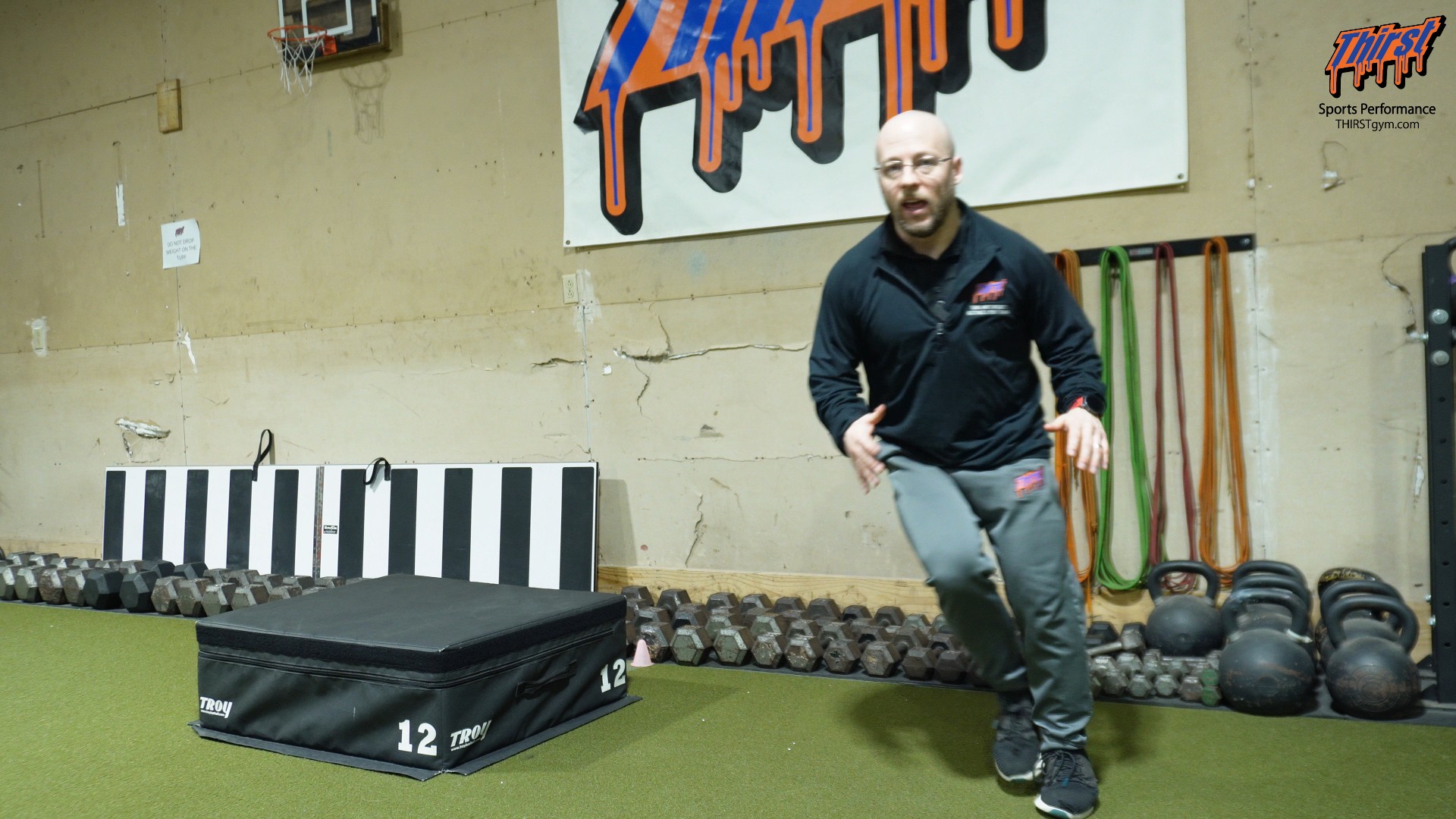
Single-Leg Lateral Depth Drop to Lateral Bound: Build Frontal-Plane Power and Change-of-Direction Speed
Most athletes spend the overwhelming majority of their training moving straight ahead. They sprint forward, they jump vertically, they squat and pull in the sagittal plane, and then they wonder why they feel stiff, slow, and a step behind whenever a game or a match forces them to move sideways. Sport rarely happens in a straight line. Wrestlers shuffle and re-position, fighters cut angles, defensive backs mirror a receiver’s break, and basketball players slide and explode laterally hundreds of times in a single game. If your training never teaches your body to absorb force on one leg and immediately redirect it to the side, you’re leaving a huge amount of athletic potential on the table.
The single-leg lateral depth drop to lateral bound is one of the most effective exercises for closing that gap. It trains reactive strength, frontal-plane power, and single-leg force absorption all in one movement, and it does so in a way that transfers directly to the kind of quick, decisive, side-to-side action that separates good athletes from great ones. This guide breaks down exactly why the exercise works, how to set it up, how to perform it with clean technique, the mistakes that quietly ruin it, and how to program it so it actually makes you faster.
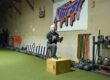
Watch the video below on how to maximize this exercise.
Why This Exercise Belongs in Your Training
To understand what makes this drill so valuable, you have to understand what’s happening under the hood. When you step off a box and land, your muscles and tendons are forced to rapidly absorb impact. That absorption phase is an eccentric contraction, and it loads your tissues like a spring. The single-leg lateral depth drop to lateral bound takes that loaded spring and immediately asks you to redirect all of that stored energy horizontally, to the side, off of one leg. This is the stretch-shortening cycle in action, and it’s the foundation of nearly every explosive athletic movement.
What makes the frontal-plane version special is that it trains a direction most athletes neglect. Vertical jumps and standard depth drops build power in the up-and-down and forward directions, but changing direction, cutting, and lateral acceleration all live in the frontal plane. By dropping off the box laterally and then bounding to the side, you’re teaching your nervous system and your connective tissue to produce and tolerate force in exactly the plane where sport demands it.
Loading a single leg is the other piece of the puzzle. Landing and pushing off one leg dramatically increases the force each leg has to handle compared to a two-footed variation. That extra loading builds resilience in the hips, knees, and ankles, and it exposes and corrects the side-to-side imbalances that almost every athlete carries. There’s also a hidden benefit here that’s worth calling out: if the box is set higher than an athlete could jump up to off a single leg on their own, the depth drop still delivers a training effect their unassisted jump couldn’t provide. In other words, the box lets you overload the landing beyond what the athlete could self-generate, and that overload transfers straight into the power of the lateral push on the bound.
Equipment and Setup
The equipment list is refreshingly simple. All you need is a plyometric box and enough open floor to the side of it to bound and land safely. Box height is where the real decision-making happens, and it matters far more than most people assume.
Start low to moderate. A 12-inch box works well for the majority of athletes, and there’s nothing wrong with dropping down to 6 inches when someone is new to the movement or still learning to land cleanly. From there you can progress up to 18 inches, and eventually 24 inches for your more advanced, elite-level athletes. Be honest with yourself here: 24 inches is genuinely pushing the ceiling for this drill, and it’s only appropriate for athletes who have earned it with quality reps at lower heights. The height is a tool, not a trophy, and chasing a taller box before the movement is clean will make the exercise worse, not better.
Once you’ve picked your height, set your feet. This is a detail people get wrong constantly. You do not want to stand in the middle of the box. Instead, you want to hug the edge of the box on the side you’re going to drop toward. If you’re going to bound off to your left, stand on the left edge. Standing centered forces you to travel across the box surface before you even reach the drop, which kills the timing of the movement and adds an awkward extra step. Hugging the edge means the moment you step off, you’re already in position to land and redirect.
Step-by-Step Technique
Set up standing on the edge of the box on one leg. For the sake of example, imagine you’re positioned on the left side of the box and you intend to bound to your left. You’ll stand on your right leg, because the leg you land and push off of is the one that does the work.
From that single-leg stance on the edge, step or hop off the box toward your left. You’re not launching yourself for height or distance off the box; you’re simply dropping off the edge so that gravity delivers you to the floor. Land on that same right leg. The instant your foot contacts the ground, you drive off it and bound laterally to your left, covering as much horizontal distance as you can, and you land on the opposite leg, your left, sticking that landing under control.
The single most important coaching point in the entire movement is minimizing ground contact time. When you hit the floor off the box, the goal is to touch and go. As soon as your toe makes contact, you should already be redirecting sideways. Think of the ground as being hot, something you want to spend as little time on as possible. That first landing is not a rest stop; it’s the loading and firing of the spring, and it should happen almost instantly.
The intent of the bound is distance, not height. This is a subtle but crucial distinction. A lot of athletes instinctively try to jump up and over on the bound, but that’s not the point. You want to get your impact absorbed the moment you hit the ground and then travel as far sideways as you possibly can, finishing by sticking the landing on the opposite leg. Reaching for horizontal distance keeps the movement fast and low, which is exactly how change of direction looks in real competition.
Muscles Worked and Athletic Qualities Trained
This is a full lower-body reactive drill, but a few areas carry the heaviest load. The glutes, particularly the gluteus medius and the deep hip stabilizers, do an enormous amount of work controlling the single-leg landing and driving the lateral push. The quadriceps and hamstrings manage the eccentric absorption of the depth drop and contribute to the concentric drive of the bound. The adductors and the entire frontal-plane hip musculature are heavily involved because you’re producing and controlling force side to side rather than front to back. Down the chain, the calves, the ankle complex, and the small stabilizing muscles of the foot handle the rapid ground contact and help you stay springy and reactive.
Beyond specific muscles, the qualities this exercise develops are what make it so valuable. You’re building reactive strength, the ability to absorb and immediately return force. You’re developing frontal-plane power, the horizontal, lateral output that fuels cuts and change of direction. You’re improving single-leg force absorption and the resilience that comes with it. And you’re sharpening the coordination and foot speed that let an athlete plant, redirect, and go without hesitation.
Common Mistakes to Avoid
The most frequent and most damaging mistake is using a box that’s too high. Here’s the tell: if you land off the box and feel like you’re stuck to the ground, absorbing a heavy landing before you can push sideways, the box is too tall for you right now. The entire value of the drill lives in that quick transition from landing to bound. When the drop is so high that you’re forced to sink, stabilize, and then redirect, you’ve turned a reactive power exercise into a slow, grinding landing drill. As soon as you notice you can’t reapply force to the side quickly, drop the height. Fast and low always beats high and heavy for this movement.
The second common mistake is chasing height on the bound instead of distance. Jumping up and over might feel more impressive, but it works against the goal. Sport-specific change of direction is horizontal and low to the ground, so your bound should be too. Keep your intent on covering ground sideways, not on getting air.
A third issue is sloppy landing mechanics, especially on the final stick. If the knee caves inward, the ankle rolls, or the athlete crashes down without control, the exercise stops building resilience and starts inviting injury. Every landing, both the depth-drop landing and the final bound landing, should be controlled, with the knee tracking in line with the foot and the hip, ankle, and knee sharing the load. Sticking the landing under control is a non-negotiable part of the rep, not an afterthought.
Finally, watch for excessive ground contact time creeping in as fatigue sets in. The drill only works when it stays crisp. The moment your reps get slow and heavy on the ground, the quality is gone, and continuing to push through only reinforces bad patterns.
Programming Recommendations
Because this is a more advanced, high-intent movement, quality has to come before quantity every single time. A rep that’s slow, stuck, or out of control is worse than no rep at all, so the volume you use should always protect the crispness of the movement.
A reliable starting point is three to five reps per leg for three to five sets. That range gives you enough exposure to build the quality you’re after without letting fatigue degrade your ground contact time and landing control. Keep rest generous between sets so every rep is fast and reactive; this is not a conditioning drill, and treating it like one defeats the purpose.
Place this exercise early in your session when your nervous system is fresh, ideally after a thorough warm-up but before any heavy strength work or fatiguing conditioning. Power and reactive-strength drills should be trained in a rested state so you can express maximum speed and intent on every rep.
Progression happens on two fronts, and both should advance gradually. You can build up the number of quality repetitions over time, and you can increase the box height as the athlete demonstrates they can still land and redirect quickly at the current height. The rule that governs both is the same: only progress when the movement stays fast. If adding height or volume makes the athlete slower on the ground, you’ve gone too far and should scale back. Master the movement at a given height before you reach for the next one.
Who Should Be Doing This Exercise
This drill is a natural fit for any athlete who needs to change direction, move efficiently in the frontal plane, develop quick feet, and immediately produce and display power to the side. That covers a huge swath of the athletic world. Wrestlers and grapplers who constantly re-position and scramble benefit enormously from the single-leg lateral force production. Combat sports athletes and MMA fighters who cut angles and shift their base rely on exactly this kind of reactive lateral power. Court and field athletes across basketball, football, soccer, and tennis live and die by their ability to plant, redirect, and accelerate sideways.
It’s also a valuable tool for youth and developing athletes, provided the height is kept appropriate and the emphasis stays firmly on clean landings and quick, controlled movement. For younger athletes, a 6-inch box and a focus on sticking every landing builds the foundation they’ll draw on for years. The beauty of this exercise is its scalability: the same movement pattern serves a 14-year-old learning to control their body and an elite competitor overloading a 24-inch drop, simply by adjusting the height and the intent.
Final Thoughts
The single-leg lateral depth drop to lateral bound earns its place in a program because it trains the real demands of sport: absorbing force on one leg and instantly redirecting it to the side, fast and low, under control. Set the box at a height that keeps you quick, hug the edge, minimize your ground contact time, bound for distance rather than height, and stick every landing. Keep the volume conservative, prioritize quality relentlessly, and progress only when the movement stays sharp. Do that consistently, and you’ll build the kind of frontal-plane power and change-of-direction speed that shows up when it matters most.