
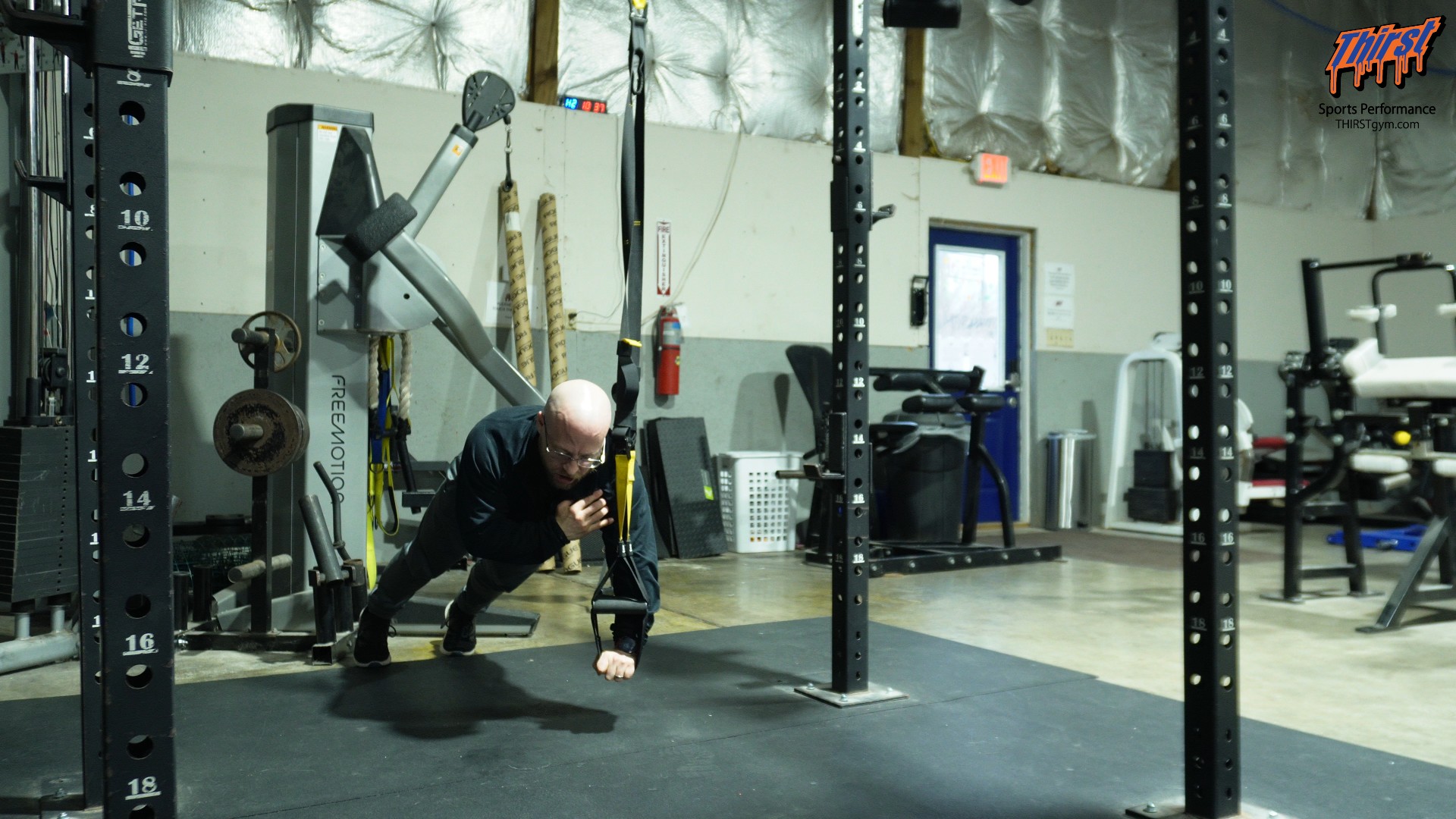
Offset TRX Push-Up with Shoulder Tap: How to Master This Advanced Push-Up Variation
The offset TRX push-up with shoulder tap is one of the most demanding bodyweight pressing exercises you can add to a training program, and it earns that reputation honestly. It layers unilateral pressing strength, shoulder stability, serratus anterior activation, and hard anti-rotation core work into a single movement. If you have plateaued on standard push-ups and you are looking for a variation that challenges the upper body and trunk in a way that carries over to real athletic performance, this is a movement worth learning. Below is a complete breakdown of why it works, how to set it up, how to execute it with clean technique, the mistakes to avoid, and how to program it for everyone from powerlifters to combat sports athletes.
Watch the video below on how to maximize this exercise.
Why This Push-Up Variation Is Worth Your Time
Most people treat the push-up as a beginner exercise, something to graduate away from once the bench press enters the picture. That is a mistake. The push-up is a closed-chain pressing movement that trains the scapula to move freely, and free scapular motion is exactly what a barbell bench press restricts. When your back is pinned to a bench, your shoulder blades cannot glide the way they are designed to. The push-up restores that natural motion, and the offset TRX version amplifies it.
What makes this particular variation so valuable is that it attacks several qualities at once. By placing both hands into suspension straps on one side while the opposite hand presses from the floor, you create an asymmetrical loading pattern. The arm on the ground ends up doing the overwhelming majority of the pressing work, which turns a bilateral exercise into a near-unilateral one. Then the shoulder tap at the top forces you to resist rotation through the trunk while one arm is completely unweighted and reaching. The result is a movement that builds pressing strength, exposes and corrects left-to-right imbalances, and demands genuine core control the entire time.
For athletes, this transfer matters. Wrestlers, grapplers, and mixed martial artists are constantly pressing, posting, and stabilizing from unstable positions with uneven loads. A push-up that trains one arm to carry the load while the trunk resists rotation mirrors those demands far better than a symmetrical press ever could.
Equipment You Will Need
The setup for this exercise is simple, but the details matter. You need a suspension trainer with a pair of handles, mounted so that the straps hang low to the ground. This is the part people tend to get wrong. You want the handles sitting roughly six to eight inches off the floor, not up at hip height. If you set the straps too high, the exercise becomes nearly impossible to perform with any quality, because your loaded arm cannot travel through a usable range of motion.
In a gym setting, the easiest approach is to drop the straps all the way down to their lowest setting and work from there. That low anchor point keeps your body close to the floor and lets the pressing arm do its job without the suspension side riding up awkwardly. Beyond the straps, all you need is enough clear floor space to get into a full push-up position and a surface that is comfortable for your grounded hand.
Step-by-Step Technique
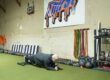
Begin by lowering the suspension handles until they sit just a few inches off the ground. Place both hands into the handles on one side of your body, so that both wrists are stacked into the straps together. Your opposite hand goes flat on the floor in a standard push-up position, roughly under your shoulder. From here you are in an offset push-up stance: one side supported by the suspension trainer, the other side planted on the ground.
Set your body in a rigid plank. Brace your abdominals, squeeze your glutes, and keep a straight line from the crown of your head through your heels. This tension is not optional, it is what allows you to control the descent under asymmetrical load.
Lower yourself into the push-up. Because both of your suspension-side wrists are working together and slightly elevated, your grounded arm receives most of the pressing demand. Descend under control and let the ground-side arm absorb the load eccentrically. This is the slow, muscle-building portion of the rep, and it is where a large part of the strength benefit lives.
Press back up through the grounded arm. As you reach the top of the push-up, extend the grounded arm to full support, then reach across your body with the opposite hand and briefly tap the opposite shoulder. The tap should be light and quick. The goal is not the tap itself but everything your body has to do to stay level while you perform it. Return the reaching hand to the strap, reset your brace, and repeat.
Complete your target number of repetitions on one side, then switch the strap and floor positions to train the other side equally.
Muscles Worked
This is a genuine full-body upper body exercise, and understanding what it trains helps you program it intelligently.
The primary movers on the press are the pectorals, triceps, and anterior deltoids, just as in any push-up. What sets the offset version apart is how heavily it loads one side at a time. Because the grounded arm handles most of the pressing, you get a strong unilateral training effect on the chest, triceps, and front of the shoulder, which is excellent for ironing out strength differences between your left and right sides.
The reaching arm delivers a different benefit. When you extend it long to tap the opposite shoulder, you drive serratus anterior activation on that side. The serratus anterior is the muscle responsible for protracting the scapula and keeping it flush against the rib cage, and it is chronically underdeveloped in lifters who only train pressing from a bench. Reaching long trains it directly.
Alongside the serratus work, the shoulder tap demands significant shoulder stability from the supporting arm. That grounded shoulder has to stay packed and stable while it carries your entire upper body on its own for a brief moment. This is high-quality rotator cuff and scapular stabilizer training that most pressing exercises never provide.
Finally, and perhaps most importantly, the entire trunk is working the whole time. The moment you lift one hand off the floor to tap your shoulder, your body wants to rotate and dump toward the unsupported side. Resisting that rotation lights up the abdominals, obliques, and deep trunk stabilizers. This anti-rotation demand is the same quality that makes movements like the plank and the Pallof press valuable, delivered here inside a pressing pattern.
Common Mistakes to Avoid
The most frequent error is setting the straps too high. If the handles are not low to the ground, the mechanics fall apart and you lose the offset loading effect entirely. Keep them down at six to eight inches.
The second common mistake is letting the hips sag or pike during the shoulder tap. When people reach across, they often lose their plank and let the midsection collapse. If your hips are drifting, you are missing the entire point of the exercise, which is to hold a rigid, rotation-resistant trunk while one arm is off the floor. Slow the tap down and prioritize staying level over reaching fast.
A third issue is rushing the eccentric. The descent is where a huge portion of the strength and muscle-building stimulus comes from, especially for the grounded arm. Lower with control rather than dropping into the bottom.
Lastly, watch for uneven volume. Because one side always feels stronger, athletes sometimes push harder on their dominant side. Match your reps side to side so you actually correct imbalances rather than reinforce them.
Programming Recommendations
For most trainees, three to six repetitions per side is the sweet spot. Start at the lower end and build toward the top of that range over time. If you can complete six clean, controlled repetitions on each arm with a stable trunk and no sagging, your upper body and midsection are in strong shape. Getting more than six quality reps per side is a bonus, but quality always comes before quantity here.
Because this is an advanced, high-stability movement, it works best placed early in a session when you are fresh, either as a primary upper-body pressing exercise or as a heavy accessory after your main lift. It pairs well with horizontal pulling work to keep the shoulders balanced. Two or three sets per side, trained one to two times per week, is plenty for most athletes.
How to Regress the Movement
If a standard push-up is still too challenging, or the full version feels out of reach right now, there are two easy ways to scale it down without abandoning the exercise.
The first regression is to perform the entire movement from your knees. You still set up with both hands in the straps on one side and the opposite hand on the floor, you still press and reach across for the shoulder tap, but dropping to your knees removes a large portion of the load and the anti-rotation demand. It is a legitimate way to learn the pattern and build the necessary stability before progressing to the full position.
The second option is to adjust the angle by bringing your body more forward and upright relative to the straps. Walking your feet in and raising your torso simulates elevating your hands, the same way an incline push-up is easier than a floor push-up. This gives you a dial you can turn: the more upright you are, the easier the movement, and as you get stronger you gradually work back toward a flatter, more horizontal position.
Both regressions preserve the essential qualities of the exercise while meeting you where your strength currently is.
Who Should Use This Exercise
This variation fits a wide range of athletes and clients. Powerlifters can use it as accessory work to build pressing strength while restoring the scapular motion that heavy benching tends to limit. Combat sports athletes, including wrestlers, grapplers, and mixed martial artists, benefit enormously from the unilateral pressing and anti-rotation trunk demands, which mirror the uneven, unstable pressing they face on the mat and in the cage. General fitness clients who have mastered the standard push-up will find it a challenging and engaging way to keep progressing without needing additional equipment or heavy loads.
It is genuinely one of the more advanced push-up variations in circulation, and it deserves a place in a serious training toolbox precisely because it accomplishes so much in a single movement. Give it a shot, build up gradually, and pay attention to how much your trunk and shoulders have to work to keep everything stable.