
Does Lifting Weights Make You Slow? The Truth About Strength Training and Speed for Athletes
If you’re an athlete and someone has told you that lifting weights will make you slow, they gave you bad information — and it may be quietly capping your athletic ceiling. The belief that strength training kills speed and athleticism is one of the most persistent and damaging myths in all of sports performance. It has been passed down by well-meaning but misinformed coaches for decades, and along the way it has cost athletes scholarships, roster spots, championships, and years of wasted long-term development.
The reality is the opposite of the myth. Strength training, when programmed correctly, is one of the most powerful tools an athlete has for getting faster, more explosive, and more durable. This article breaks down exactly what the research says, why the myth exists in the first place, and how to build a program that develops strength and speed at the same time. Everything here reflects how athletes are actually trained in the weight room every day — no fluff, no fitness-industry mythology.
You can also watch the video below that goes along with this article.
Where the “Lifting Makes You Slow” Myth Actually Comes From
Understanding why this myth took hold makes it much easier to see why it’s wrong. It traces back to three sources, and none of them holds up under scrutiny.
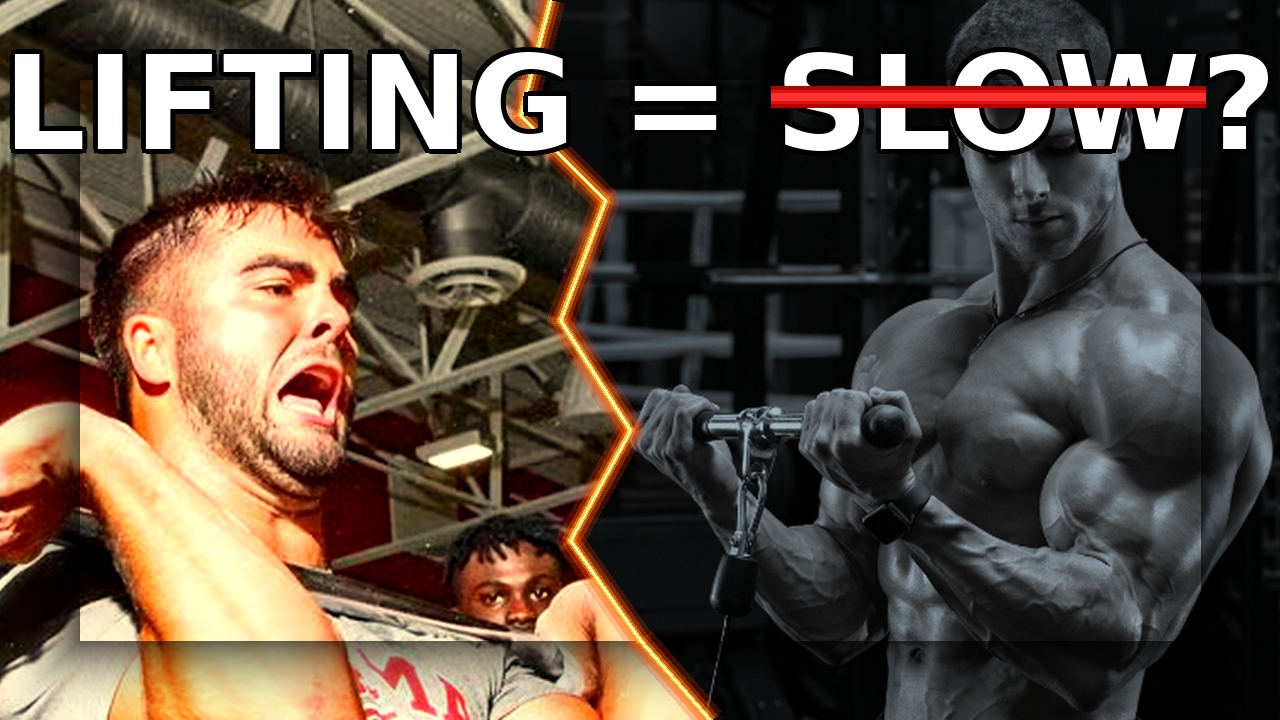
The first is the bodybuilder stereotype. Most of us grew up seeing 250-pound physique competitors in magazines who looked like they moved through peanut butter — stiff, slow, and struggling to walk around comfortably. People saw those images and concluded that lifting turns you into that. But a bodybuilder training for maximal size is not training for speed or power. Their program is built around hypertrophy: slow eccentrics, isolation movements, high volume, and zero emphasis on rate of force development. That’s not a strength-training problem — that’s a program built for a completely different goal. Train for a different outcome and you get a different athlete.
The second source is the confusion between muscle mass and muscle function. More muscle does not automatically make you slower. What matters is the training stimulus and the adaptations you’re driving. Muscle built through explosive, athletic training behaves very differently on the field than muscle built through slow, isolated bodybuilding work. The tissue is not the problem; the training intent is.
The third source — and this is the big one — is coaches who don’t understand the force-velocity curve. They watch an athlete add fifty pounds to their squat, don’t see an instant improvement in forty-yard dash time, and conclude that lifting doesn’t transfer. What they’re actually running into is the transfer problem, which is real, solvable, and has nothing to do with strength making anyone slow. We’ll cover it in detail below.
What the Research Actually Says About Strength Training and Speed
The science here is not ambiguous. A large 2016 review published in the British Journal of Sports Medicine pooled more than two dozen studies and thousands of athletes. It found that structured strength training reduced sports injuries by roughly a third and cut overuse injuries by nearly half. Just as importantly for this conversation, it found no evidence — none — that strength training impaired speed or athletic performance in any population studied.
Dig deeper and the picture gets even clearer. Research examining the relationship between maximal strength and athletic qualities has repeatedly shown that athletes with higher relative strength — strength measured against their own body weight — consistently demonstrate faster sprint times, higher vertical jumps, and better change-of-direction ability than their weaker counterparts. Across essentially every metric that matters for athleticism, stronger athletes tested better. Let that land for a second: the stronger athletes were faster, not slower.
Work by Cormie and colleagues demonstrated that after a strength-training intervention, athletes improved their rate of force development by more than twenty percent with no loss of movement velocity. In other words, they got stronger and stayed fast. And a frequently cited strength threshold in the literature suggests that a squat of roughly one-and-a-half to two times body weight functions as something close to a prerequisite for elite sprint performance — athletes below that threshold tend to underperform in speed testing no matter how much sprint work they log.
The takeaway from the body of research is blunt: strength doesn’t make you slow. Weakness makes you slow. A lack of strength is a hard ceiling on your speed potential, and no amount of dedicated sprint work fully compensates for a weak force base.
The Force-Velocity Curve: Why Getting Stronger Makes You Faster
To understand why the research keeps landing the same way, you have to understand what actually produces speed. Sprint speed comes down to how much force you can put into the ground relative to your body mass, within an extremely short ground-contact window — often between 80 and 120 milliseconds. That’s a fraction of a blink. The faster and harder you can express force into the ground in that tiny window, the faster you accelerate, the higher you jump, and the sharper you cut.
This is where the force-velocity curve comes in. Every athlete has a curve that describes how much force they can produce at any given movement speed. When you increase your maximum force capacity through heavy strength training, you shift that entire curve upward. The practical result is that at any velocity — including the very high velocities of sprinting and jumping — you can now produce more force than before. More ground reaction force means more acceleration, which means a higher top-end speed. Strength doesn’t sit in a separate box from speed; it raises the foundation that speed is built on.
This is exactly why a stronger athlete, all else being equal, has more room to become a faster athlete. You cannot express force you don’t have.
The Transfer Problem: Why Some Athletes Lift and Don’t Get Faster
Here’s the honest part. Sometimes an athlete starts lifting and doesn’t immediately get faster. That happens — but it is never because lifting made them slow. It’s because of the transfer problem, and the fix is in the programming, not in abandoning the weight room.
Think of strength as a general quality — a broad foundation — and speed as a specific quality. Between the two sits a spectrum of transfer that depends entirely on how you train. If everything you do is slow, grinding sets of five in the squat, and you never touch the explosive end of the spectrum — no jumps, no throws, no weightlifting variations, no attention to bar speed — then yes, your transfer to sprinting will be poor. But the squat didn’t slow you down. Incomplete programming did. You built the engine and never learned to rev it.
Intelligent sports performance programming solves this by training multiple points on the force-velocity curve within the same block, sometimes within the same week or even the same session. Heavy maximal-strength work gets paired with explosive power development so the two qualities reinforce each other instead of competing. This is the logic behind concurrent and conjugate training models, and it’s the difference between an athlete who is strong and an athlete who can use their strength at game speed.
The Three Buckets Every Athlete Needs
A program built to make an athlete both strong and fast needs to fill three distinct buckets. Drop any one of them and you leave performance on the table.
Bucket One: Maximal Strength
This is your heavy foundational work — squats, deadlifts, presses, and their variations — trained in roughly the 80–90% of one-rep-max range for sets of two to five reps. This is the bucket that builds your top-end force ceiling. Without it, everything downstream is limited, because you can’t develop explosive power off a force base that isn’t there. Coaching cue: keep intent high even at heavy loads — you should be trying to move the bar fast, even when the bar itself is moving slowly.
Bucket Two: Explosive Power
This bucket trains rate of force development — how quickly you can produce force. It includes jump variations, medicine-ball throws, and Olympic lifting derivatives like cleans and snatches, all performed at high velocity with full recovery between sets. The full-recovery piece is where many programs fail: power work done in a fatigued state turns into conditioning and loses its explosive quality. Fewer, crisper, high-effort reps beat grinding through fatigue every time.
Bucket Three: Sport-Specific Speed
This is the actual sprint work, agility drills, change-of-direction training, and sport skill practice performed at true game speed. This is where the transfer physically happens — where the raised force ceiling and improved rate of force development get expressed in the movements that matter for competition. Strength and power feed this bucket; they don’t replace it.
Drop the strength bucket and you cap your force ceiling. Drop the power bucket and you can’t express strength quickly. Drop the speed bucket and none of it transfers to the field. All three together form a system, and the system is what optimizes performance.
Common Mistakes That Make Athletes Look “Slow” From Lifting
The athletes who seem to get slower after starting to lift almost always fall into predictable traps. They train exclusively heavy and never touch the explosive end of the curve. They add so much volume that they show up to practice chronically fatigued and can’t sprint fresh. They chase bodybuilding-style pumps and isolation work at the expense of compound, athletic movement. Or they neglect sprint and agility work entirely, assuming the squat alone will make them fast on the field.
None of these are strength problems. They’re programming and implementation problems. Fix the program and the “slowness” disappears — usually it converts into new speed.
What the Fastest Athletes in the World Actually Do
If the research isn’t enough, look at what elite athletes are actually doing. Every year the NFL Combine produces its share of freak athletes, and those athletes are not avoiding the weight room — they live in it. The same is true of Olympic sprinters, elite jumpers, and, in the combat sports world, high-level wrestlers. Serious strength training is a defining feature of the most explosive athletes on the planet, not an obstacle to their speed.
In wrestling specifically, a decade-plus of coaching points to the same pattern over and over: the athletes who get strongest relative to their body weight are almost always the most explosive on the mat. It’s rarely close. Take two athletes of equal skill and the stronger one, with more training experience, is usually the better competitor when everything else is held equal. Strength doesn’t compete with athleticism; it amplifies it.
Using Velocity-Based Training to Lift With Intent
For more advanced athletes — typically high school age and up — a bar velocity tracking device can sharpen the whole process. Velocity-based training lets you see, in real time, whether you’re grinding reps that should be moving fast, which tells you exactly where you’re sitting on the force-velocity curve on a given day. If your bar speed is consistently slow on work that’s supposed to be explosive, that’s a signal to adjust load and restore speed so the training adaptation transfers to sport.
VBT isn’t required to make progress, and younger or newer athletes don’t need it. But for developed athletes trying to fine-tune the balance between heavy strength and explosive speed-strength, it removes the guesswork and keeps every rep pointed at the right adaptation.
Your Strength Standard: The 1.5–2x Body Weight Squat
Somewhere in the peak of an athlete’s development, a reasonable general target for lower-body strength is a squat around one-and-a-half to two times body weight — leaning toward one-and-a-half for many female athletes and closer to two for many male athletes. Sit meaningfully below that and you likely have a strength deficit that’s limiting your speed and power output.
This is a guideline, not a law. There are genetic outliers who succeed without hitting it. But as a foundation, that ratio tends to indicate enough lower-body strength to support elite athletic movement. Once you’re there, the game shifts to refining transfer — moving heavier loads faster and sharpening rate of force development. If you’re not there yet, building that base is one of the highest-return investments you can make in your speed.
The Bottom Line for Athletes, Coaches, and Parents
Strength training does not make athletes slow. Bad programming and poor implementation make athletes slow. Avoiding the weight room, on the other hand, makes athletes weak, fragile, and slower than they could be.
If you’re an athlete who isn’t strength training at all, you are leaving speed, power, and durability on the table — full stop. With consistent, methodical training, meaningful progress typically shows up within twelve to twenty-four weeks. If you already lift, remember that how you lift matters just as much as that you lift: train across the full force-velocity spectrum, cover all three buckets, and lift with genuine intent on every rep. Do that, and the weight room becomes the single biggest accelerant for your athletic performance — not the thing holding it back.
Want help improving your athletic performance? Contact us to see how we can help you!