

The Lateral Lunge with Plate Reach: A Coach’s Guide to Building Better Lateral Movement
Most strength programs are built almost entirely in one direction. We squat up and down, we hinge front to back, we press and pull through a single plane of motion, and then we wonder why athletes feel stiff, unstable, or downright awkward the moment they have to move sideways. The truth is that sport rarely happens in a straight line. Wrestlers shoot and sprawl across the mat, fighters circle and cut angles, field and court athletes change direction constantly, and even general fitness clients need to be able to step laterally to catch their balance or reach for something on the floor without tweaking a knee or hip. If you only ever train forward and backward, you leave a massive gap in an athlete’s foundation.
That gap is exactly where the lateral lunge with plate reach earns its place. It’s a simple, low-cost, high-value exercise that teaches people how to load their hips and move efficiently in the frontal plane. It looks unassuming, but it solves one of the most common movement problems coaches run into: athletes who genuinely don’t know how to lateral lunge correctly. This article breaks down what the exercise is, why the plate reach matters so much, how to coach it step by step, the mistakes to watch for, and how to progress it once your athletes have earned the right to load it.
Watch the video below on how to maximize this exercise.
Why Lateral Movement Deserves a Spot in Your Programming
Before getting into the mechanics, it’s worth understanding why frontal-plane work matters in the first place. The human body moves in three planes of motion: the sagittal plane (forward and backward), the frontal plane (side to side), and the transverse plane (rotation). The vast majority of gym training lives in the sagittal plane. Squats, deadlifts, lunges, presses, rows — almost all of it happens front to back. That’s not a bad thing, but it’s incomplete.
The frontal plane is where lateral lunges, side shuffles, and crossover work live, and it’s a plane that demands a very different kind of hip control. When you move sideways, you have to be able to sit into one hip, decelerate your body weight, and then drive back to center. That ability to absorb force laterally and redirect it is the foundation of change of direction, cutting, and balance recovery. For combat sports athletes especially — wrestlers, MMA fighters, grapplers — the capacity to load a hip and explode laterally can be the difference between scoring a takedown and getting taken down. The lateral lunge is one of the cleanest ways to start building that quality, and the plate reach version is the on-ramp.
What the Lateral Lunge with Plate Reach Actually Is
The setup is about as simple as it gets. You need a single plate held against your chest. A 5 kilogram or 11-pound bumper plate works beautifully because the larger diameter is comfortable to hold, but a standard 5- or 10-pound iron plate that you’d normally load on a barbell will do the job just the same. The equipment is interchangeable; what matters is the weight, and we’ll come back to why that number is so important.
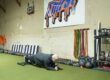
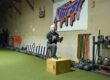
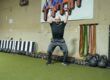
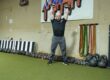
You start standing with both feet together, holding the plate to your chest as though you’re gripping a steering wheel. From there, you step laterally to one side and lower into a lunge. As you descend, you simultaneously press the plate straight out in front of you, extending your arms. As you push back to the starting position, you pull the plate back into your chest. That’s one rep. Step out, reach, return. The movement of the plate is synchronized with the movement of your body, and that coordination is the whole point.
It’s helpful to think of the plate as doing a job for you rather than just being weight you’re holding. You’re not curling it or pressing it for the sake of working your arms. The plate is a tool that changes where your center of mass sits, and that single change is what makes this exercise so effective as a teaching drill.
The Counterbalance: Why the Plate Reach Works
Here’s the magic of the movement, and the reason it’s worth doing instead of a plain bodyweight lateral lunge. When you reach the plate out in front of you, you create a counterbalance. Your body weight wants to keep you upright and pull you backward, but the plate extended in front shifts your center of mass forward. That forward shift gives you permission to sit your hips back and down into the working hip far more than you could without it.
If you’ve ever watched someone try to lateral lunge with no load, you’ve probably seen them stay stiff and upright, barely bending the hip and dumping all the stress into the knee. They simply can’t get into the position because they have nothing to counterbalance against. The instant you hand them a plate and cue the reach, the movement transforms. Suddenly they can sit back into the rear hip, the knee tracks more naturally over the midfoot, and they reach a depth that was completely inaccessible a moment earlier. The plate reach is essentially a self-correcting mechanism: the reach forces the hips back, and hips-back is exactly the position we’re trying to teach.
This is why I treat this primarily as a teaching exercise. The load isn’t there to build maximal strength. It’s there to unlock a movement pattern that most people can’t access on their own.
Choosing the Right Weight (and Why Heavier Is Worse)
The temptation with any loaded exercise is to grab something heavier and assume you’re getting more out of it. With the lateral lunge with plate reach, that instinct works against you. The sweet spot is 5 to 10 pounds. Once you climb into 25-pound territory, the exercise fundamentally changes character.
The reason comes back to the reach. When you press a heavy plate out in front of your body, your shoulders have to work hard to support and stabilize that load at the end range of the reach. At 25 pounds, the shoulders become the limiting factor, and the drill quietly turns into a shoulder and anterior-deltoid challenge rather than a lower-body movement-quality exercise. You’ll fatigue the upper body long before you’ve taught the hips anything useful. Keeping the plate light ensures the focus stays exactly where it belongs: on learning to load the hip and lunge laterally with clean mechanics.
Coaching the Movement: Foot Position and Knee Tracking
Two technical details separate a good rep from a sloppy one, and both are worth cueing carefully.
The first is foot position. As you step laterally, your stepping foot should stay relatively forward and straight. A slight angle of roughly 10 to 20 degrees is completely fine and natural for most people. What you want to avoid is turning the foot way out to the side toward a 45-degree angle, because that takes you into more of a sumo-style position rather than a true lateral lunge. Keeping the foot pointed forward forces the hip to do the work of internally organizing the movement, which is the entire training stimulus we’re after.
The second detail is knee tracking. Your knee should not shoot out aggressively to the side. The goal is for the knee to track more naturally over the midfoot as you sit back into the hip. This is where the counterbalance pays off again — because the reach lets you sit your weight back into the rear hip, the knee follows a cleaner path over the foot instead of caving in or sliding out past the toes. If you see a knee blowing out wide or tracking poorly, it’s almost always a sign the athlete isn’t sitting back enough, and reinforcing the reach usually fixes it on the spot.
Common Mistakes to Watch For
A few errors show up again and again with this exercise. The most common is staying too upright and failing to commit to the reach, which eliminates the counterbalance and defeats the purpose. Another is letting the stepping foot rotate too far out, sliding into that sumo position and losing the lateral quality of the movement. A third is going too heavy, which shifts the demand to the shoulders as described above. And finally, some people rush the tempo, bouncing in and out of the bottom rather than controlling the descent and feeling the hip load. Slow it down, own the position, and let the hip do the work.
Who Should Be Doing This Exercise
The honest answer is almost everyone, because the underlying skill it teaches is universal. Combat sports athletes — wrestlers, MMA fighters, grapplers — benefit enormously because lateral hip loading directly transfers to their sport’s demands. Powerlifters and general strength athletes benefit because building frontal-plane competence rounds out a program that’s otherwise dominated by sagittal-plane lifting, and healthier hips tend to mean a healthier squat and deadlift down the line. General fitness clients benefit because lateral strength and balance translate directly into everyday resilience and reduced injury risk. And for anyone learning to lunge sideways for the first time, this is the most forgiving and instructive entry point available.
It also works beautifully across experience levels. A beginner uses it to learn the movement from scratch. A more advanced athlete can use it as a warm-up primer to groove the pattern before heavier lateral work, or even as a conditioning tool when programmed for higher volume and a quicker pace.
Programming: Sets, Reps, and Where It Fits
Because this is primarily a teaching and movement-quality exercise, you don’t need a ton of volume to get the benefit. Two to three sets of 8 to 12 reps on each side is a reliable starting point. That rep range gives an athlete enough exposure to start ingraining the pattern without burning them out, and it keeps the quality high across every rep. If you’re using it as a conditioning piece instead, you can extend the volume and increase the pace, but for movement teaching, quality beats quantity every time.
In terms of placement, it fits naturally early in a session as part of a movement-prep block or as the first lower-body exercise before heavier work. It primes the hips, reinforces a clean lateral pattern, and gets the body ready to handle more demanding loading later in the workout.
Progressing the Lateral Lunge
The lateral lunge with plate reach is the on-ramp, not the destination. Once an athlete can consistently hit the right positions — sitting back into the hip, tracking the knee cleanly over the midfoot, keeping the foot relatively forward — it’s time to actually load the movement. From here you can progress to a goblet lateral lunge, where you hold a kettlebell or dumbbell at the chest and lunge under real load. You can also reach for a sandbag, which adds an unstable, shifting load that further challenges hip control, or any number of other implements depending on your goals and equipment.
The key principle is that you earn the right to load. The plate reach version exists to teach the pattern. Once the pattern is owned, loading it is where the real strength and power development begins. Skipping that teaching step and loading a broken pattern is how people end up frustrated, stalled, or hurt — so resist the urge to rush.
Final Thoughts
The lateral lunge with plate reach is one of those exercises that punches well above its weight. It costs nothing more than a light plate, it teaches a movement most people genuinely struggle to perform, and it builds a frontal-plane foundation that pays dividends across nearly every sport and every fitness goal. The counterbalance created by the reach does the heavy lifting from a coaching standpoint, making the right position almost automatic for athletes who’ve never been able to find it before. Coach the foot position, cue the reach, keep the load light, and watch your athletes finally start to move well sideways.
At THIRST Gym in Terre Haute, Indiana, lateral movement is a non-negotiable part of how we build resilient, well-rounded athletes — and exercises like this one are exactly how we lay that groundwork. If you give it a try with your own athletes or clients, I’d love to hear how it goes.