
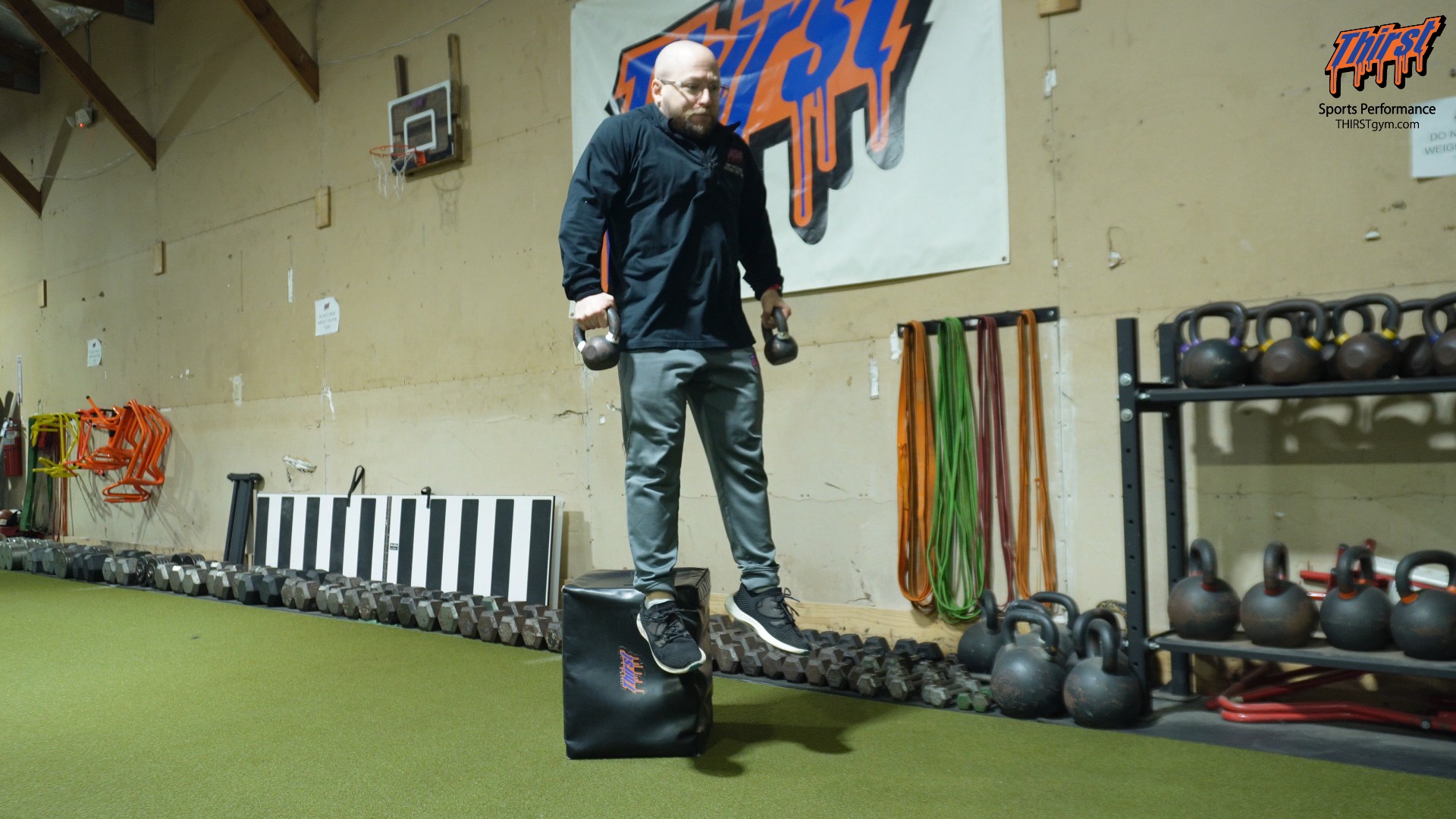
The Seated Weighted Vertical Jump: Building Explosive Starting Power and Rate of Force Development
Every athlete wants a more explosive first step. Whether you’re shooting for a takedown on the wrestling mat, exploding out of a three-point stance, or driving off the line in the first fraction of a second, the ability to produce force fast is often what separates good athletes from great ones. The seated weighted vertical jump is one of the most effective and underused tools for developing exactly that quality. It’s simple to set up, requires almost no equipment, and trains a specific athletic trait that most jump variations actually gloss over. In this article, we’ll break down what the exercise is, why it works, who should be using it, and exactly how to program it into your training.
Watch the video below on how to maximize this exercise.
What Is the Seated Weighted Vertical Jump?
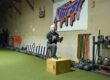
The seated weighted vertical jump is a concentric-only jump performed from a seated position on a box, while holding a light weight in each hand. Instead of starting from a standing position and dipping down before you leap, you begin the movement from a complete dead stop while seated. From there, you drive your feet into the ground and jump as high as you can, holding light kettlebells or dumbbells at your sides the entire time.
What makes this variation unique is that it removes two things athletes usually rely on: the countermovement dip and the arm swing. Because you’re holding a weight in each hand, you can’t throw your arms upward to generate momentum, and because you’re starting from the bottom of a seated position, there’s no downward dip to load your muscles and tendons like a spring. The result is a jump that forces your muscles to produce force from a completely stationary, disadvantaged position — which is precisely the point.
Why Start From a Dead Seated Position? Removing the Stretch-Shortening Cycle
To understand why the seated start matters, you need to understand the stretch-shortening cycle (SSC). When you perform a normal vertical jump, you dip down quickly before you jump. That rapid dip stretches your muscles and tendons and stores elastic energy, almost like loading a spring. When you reverse the movement and jump, that stored energy is released and adds to your output. It’s a powerful mechanism, and most athletic movements use it constantly.
The problem is that the stretch-shortening cycle can mask an athlete’s true ability to produce force from scratch. When you begin from a seated, dead-stop position, there is no landing, no dip, and no other jump feeding into the effort. You’re eliminating the elastic contribution almost entirely. That means every bit of height you produce comes from your muscles’ ability to generate force quickly, starting from zero. This is why the seated weighted vertical jump is such a valuable diagnostic and training tool — it exposes and develops pure starting power rather than borrowed elastic energy.
Understanding Rate of Force Development
The primary quality this exercise trains is rate of force development, often abbreviated as RFD. Rate of force development simply describes how quickly you can produce force. Two athletes might be able to produce the same total amount of force, but the one who can produce it faster will almost always win the race to the first step, the takedown, or the loose ball.
This matters enormously in sport because most athletic actions happen in a tiny window of time — often under two-tenths of a second. You rarely have the luxury of a long, slow build-up to maximum force. You need force now. The seated weighted jump trains your nervous system to recruit muscle fibers rapidly and produce meaningful force in that critical early window. Because you’re starting from a dead stop and can’t rely on elastic recoil, the drill hammers this specific quality in a way that standard jumps simply don’t.
This is also why the exercise is so well-suited for improving an athlete’s first step and initial burst of acceleration. That first movement out of a static position — breaking inertia — is fundamentally a rate of force development problem, and this jump attacks it directly.
Equipment and Setup: Box Height, Stance, and Load Selection
One of the best things about the seated weighted vertical jump is how little you need to perform it. You’ll want a bit of open space, a sturdy box or object to sit on, and two light weights.
Start with the box. You want to sit so that your hips end up right around parallel or slightly above 90 degrees — meaning your hips should be roughly level with your knees or a touch higher. Getting the hips slightly above 90 degrees is ideal if your setup allows for it. This puts you in a strong starting position from which to drive.
Next, consider your load. This is where a lot of athletes get it wrong. The weights here are meant to be light — think around 10 percent of your body weight or less as a general starting point. For most people, that’s the right range. More advanced or elite athletes may be able to handle slightly more, but the goal is never to turn this into a strength exercise. In the demonstration, two 9-pound kettlebells were used, one in each hand. If you don’t have kettlebells, dumbbells work just as well, and if you don’t have either, any pair of light objects that supply a little load will do the job. A couple of pounds in each hand can go a long way, especially for lighter or younger athletes.
Finally, set your feet. This is a critical detail that’s easy to overlook. You do not want a wide goblet-squat or box-squat stance. Instead, bring your feet in to roughly hip width — the same stance you’d naturally use to jump. Your feet should be positioned so that when you explode upward, you’re jumping the way you actually jump in sport, not grinding out of a wide, strength-oriented base.
How to Perform the Seated Weighted Vertical Jump
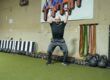
With your box set, your feet in your jump stance, and a light weight held in each hand at your sides, you’re ready to go. Hold the weights down by your sides and keep them there. Resist the urge to swing or sling them upward to help launch yourself — that defeats the entire purpose. The weights stay passive; they’re along for the ride, not the engine.
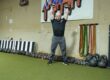
From this seated position, lean your torso forward slightly, drive your feet into the ground as hard and as fast as you possibly can, and jump as high as you can with that added weight. Focus on exploding upward with maximum intent. Stick your landing under control, then reset back onto the box before performing your next repetition. Every single rep should start fresh from that seated dead stop — you’re not bouncing, rebounding, or chaining jumps together. Reset, gather yourself, and explode again.
That deliberate reset between reps isn’t a minor detail. It’s essential to preserving the concentric-only, rate-of-force-development focus of the exercise. The moment you start bouncing off the box or rushing your reps, you reintroduce the stretch-shortening cycle and lose the very thing that makes this drill special.
Who Should Be Doing This Exercise?
The weighted version of the seated vertical jump is best reserved for high-intermediate to advanced athletes. The reasoning is straightforward. The added load is there to increase the demand and make an already-capable athlete produce even more force. But if an athlete can’t already generate a good amount of force and jump reasonably high without weight, then adding load doesn’t help — it simply slows them down and makes the movement harder to execute with speed.
Remember, this is a power and rate of force development exercise. If the weight forces an athlete to grind slowly out of the seated position, they’re no longer training explosiveness; they’re training something closer to a slow strength effort, which misses the point entirely. Athletes who aren’t yet strong or powerful enough should stick with the bodyweight version of the seated vertical jump until they’ve built a solid foundation. Once they can move well and jump with authority using just their body weight, light external load becomes a useful next step.
This progression-based approach protects athletes from doing an advanced variation before they’re ready, and it ensures the load is actually adding value rather than subtracting from speed.
Programming the Seated Weighted Vertical Jump
Because this exercise is all about producing high-quality, maximal-intent efforts, the programming reflects that. A great starting point is three to five sets of three to six repetitions. Notice how low those rep counts are — that’s intentional. Power and rate of force development are trained through freshness and quality, not through fatigue and accumulation.
Break up every single repetition individually. Rather than rattling off five jumps in a row, you reset on the box between each one, take a breath, and then produce another maximal effort. Each rep should look as crisp and explosive as the first. If your jumps start to slow down or your height drops off noticeably, that’s a sign you’ve either done too many reps or you’re not resting enough between efforts.
Place this exercise early in a training session, after your warm-up but before any heavy strength or conditioning work. Explosive power work is most effective when your nervous system is fresh and unfatigued. Trying to develop rate of force development at the end of an exhausting session is a recipe for slow, sloppy reps that train the wrong quality.
Coaching Cues and Common Mistakes
A few coaching points will help you get the most out of this drill. First, keep the weights quiet at your sides. If you notice yourself using the kettlebells or dumbbells to help fling yourself upward, drop the load or reset your intent. The arms are neutralized on purpose.
Second, respect the dead stop. The single most common mistake is turning the seated jump into a bouncy, rebounding movement. If you find yourself using momentum from the previous rep or dipping before you launch, you’ve lost the concentric-only quality. Slow down between reps and start each one truly still.
Third, don’t chase load. It’s tempting to add more weight to feel like you’re working harder, but heavier is not better here. The instant the load starts noticeably slowing your jump, you’ve gone too heavy. Err on the side of lighter weights and faster, higher jumps.
Fourth, prioritize intent. Every rep should be performed with the mindset of jumping as high as humanly possible. This is a maximal-effort exercise despite the low rep counts. Half-hearted jumps produce half-hearted adaptations.
Sport Applications: Wrestling, Combat Sports, Powerlifting, and Team Sports
The seated weighted vertical jump translates beautifully across a wide range of sports because nearly every athletic endeavor rewards the ability to produce force quickly from a static or near-static position.
For wrestlers and combat sport athletes, so much of what you do begins from a relatively still position — shooting for a takedown, exploding out of a scramble, or driving an opponent across the mat. These are pure starting-power actions, and training the dead-stop jump directly reinforces that first explosive burst.
For powerlifters, breaking the bar off the floor in a deadlift or driving out of the hole in a squat is fundamentally about generating force from a dead stop with no elastic assistance. The carryover to that initial concentric drive is obvious, and it complements the heavy strength work that fills most of a powerlifter’s program.
For team-sport athletes in football, basketball, soccer, and beyond, the first step and initial acceleration often decide who gets to the ball, the gap, or the open lane first. Since that first step is a rate of force development challenge, this exercise supports exactly the quality those athletes need most.
Where It Fits in Your Training Program
Think of the seated weighted vertical jump as a specialized tool rather than an everyday staple. It slots in nicely during phases where you’re emphasizing power development and explosive starting strength, and it pairs well with heavier strength training performed later in the same session or on complementary days. Because it’s low in volume and high in intent, it won’t leave you sore or beaten up, which means it can be sprinkled into a program regularly without adding much fatigue.
If you’re an intermediate or advanced athlete looking to sharpen your first step, improve your ability to break inertia, and build genuine rate of force development, this drill deserves a place in your toolbox. And if you’re earlier in your development, master the bodyweight version first — the weighted variation will be waiting for you when you’re ready.
Final Thoughts
The seated weighted vertical jump proves that you don’t need fancy equipment or complicated setups to train elite athletic qualities. With a box, a light pair of weights, and a commitment to maximal-intent, dead-stop reps, you can directly develop the explosive starting power that shows up in nearly every sport. Keep the loads light, reset every rep, jump with everything you’ve got, and let rate of force development do the rest.