
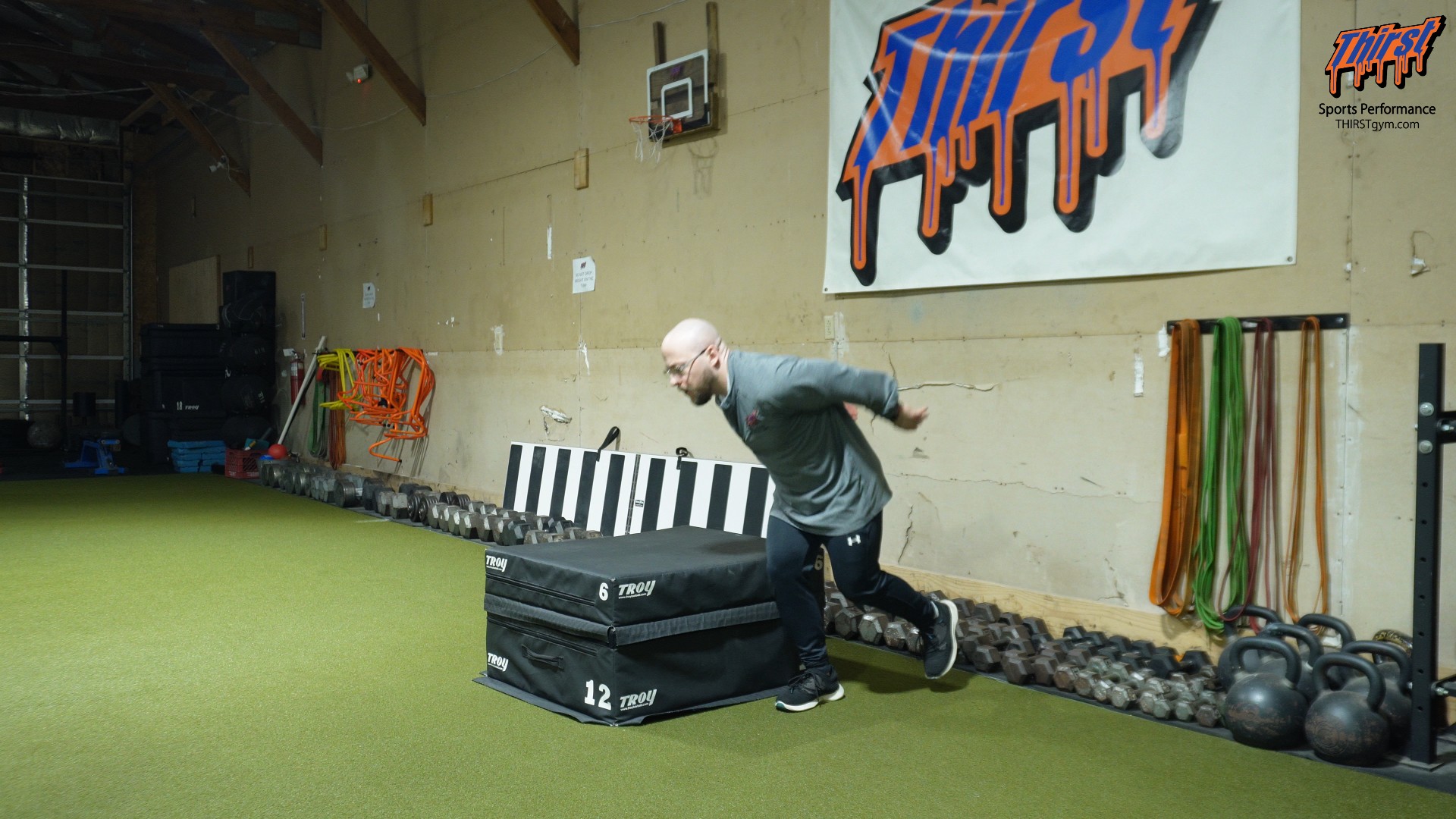
Single-Leg Lateral Box Jump to Bilateral Landing: Building Lateral Power, Change of Direction, and Hip Stability
Most box jump variations move an athlete straight up and forward. That’s useful, but it only tells half the story of how sport actually happens. Wrestlers shoot and sprawl across the mat, defenders shuffle and drive to cut off an angle, and a boxer pivots off one leg to change position. All of that is lateral, single-leg, frontal-plane work, and it rarely gets trained with the same intent that a standard vertical jump does. The single-leg lateral box jump to bilateral landing is one of the cleanest ways to fill that gap. It develops single-leg power, trains explosive movement out to the side, and reinforces a controlled two-legged landing that protects the hips, knees, and ankles all in a single drill.
This is an intermediate-to-advanced plyometric, so it isn’t the first jump you should teach a new athlete. But for someone who already owns the fundamentals, it delivers a lot of athletic value for very little equipment and time. Here’s exactly how to set it up, perform it, coach it, and program it.
Watch the video below on how to maximize this exercise.
What This Exercise Is and Why It Works
The single-leg lateral box jump to bilateral landing does what its name says: you push off the ground with one leg, travel sideways onto a box, and land on top with both feet. The single-leg takeoff forces one limb to produce all of the power, which exposes and then trains any left-to-right imbalances you have. The lateral direction shifts the demand into the frontal plane, where change of direction, cutting, and defensive movement live. And the bilateral landing lets you absorb force through two legs instead of one, which dramatically lowers the landing stress and lets you focus on producing power on the way up rather than surviving the way down.
That combination is what makes the drill so efficient. You’re getting single-leg power development, lateral or change-of-direction work, and hip stability practice all at once. For a coach who is short on time or an athlete juggling a full training week, that three-in-one quality is hard to beat.
Equipment and Setup
You need very little: a bit of open floor space and a plyometric box with a reasonably wide surface. Width matters more here than it does on a straight-ahead jump, because you’re traveling sideways and landing with both feet, so you want enough room on top to catch a stable, hip-width base. A narrow box makes the landing feel cramped and encourages a sloppy, feet-together catch that defeats the purpose.
Box height, meanwhile, should be conservative. This is not a max-height ego test. If the box is too tall, you’ll be forced to yank your knees up toward your chest and land in a deep, folded-up position with your hips buried below your knees. That’s exactly what you want to avoid. Choose a height that lets you land in a strong athletic position with your hips staying above your knees. You can always add height later once the movement is clean and powerful.
How to Perform the Movement
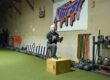
Stand to the side of the box, close enough that you’re hugging its edge rather than reaching for it. From there, you have two distinct setups, and it’s worth training both.
In the first version, you take off from the leg closest to the box — your inside leg. You drive off that single leg, travel laterally, and land squarely on top of the box with both feet. The second version flips it: you set up so you’re pushing off the outside leg and moving toward the middle of your body to get onto the box. Same landing, different demand on the takeoff leg.
To keep the two straight, it helps to think about the direction the working leg is pushing relative to your body. When the takeoff leg is driving you away from your midline and out to the side, you’re moving laterally. When the takeoff leg is driving you toward your midline, you’re moving medially. Labeling it this way keeps your programming honest and makes sure both patterns actually get trained instead of defaulting to your stronger, more comfortable side.
On every rep, the intent is the same: be as explosive as possible off the single leg, cover the distance to the middle of the box, and stick a two-footed landing. You genuinely have to get up onto the center of the box, not just clip the near edge. Land with both feet, absorb softly, and finish in a balanced athletic stance.
The Biomechanics: Why Lateral and Medial Feel So Different
Once you try both directions, you’ll immediately notice they don’t feel the same, and that’s the point.
When you push medially — driving toward your midline — the takeoff leg has to generate a lateral push-off to send you across. That means the outside of the hip and the abductors are doing a lot of work to propel you sideways. When you push laterally — driving away from your midline and out to the side — the mechanics shift, and you’ll lean more on the adductors, the inner-thigh muscles, to pull you into position and control the movement. In other words, the same drill trains two different sides of the frontal-plane equation depending on which way you set up.
This is also why the drill is such an honest diagnostic. Almost everyone has a weaker side, and it tends to show up most obviously when moving medially. If one direction feels shaky, unbalanced, or noticeably less powerful, you’ve just found an asymmetry worth addressing. That information alone makes the exercise worth doing, because frontal-plane weaknesses and adductor/abductor imbalances are frequently linked to groin strains, knee valgus, and inefficient cutting mechanics.
The bilateral landing adds one more layer. Catching with two feet trains deceleration and force absorption in a position that closely mimics the athletic stance you want in sport — knees tracking over toes, hips loaded and above the knees, chest tall. Repeating that landing pattern builds the hip stability and control that carry over to safer, sharper change of direction on the field or mat.
Coaching Cues That Keep It Clean
Explosiveness off the single leg is the headline, but the landing is where most of the quality lives. Cue athletes to be aggressive and fast on the takeoff, then quiet and controlled on the catch. The landing should be balanced, with weight centered over both feet on the middle of the box, hips clearly above the knees, and no wobble or collapse inward.
Watch for a box that’s set too high, which forces the folded-up landing you’re trying to avoid. Watch for athletes drifting to the near edge instead of getting all the way onto the box. And watch for knee valgus — knees caving inward — on either the takeoff or the landing, which signals the hip stabilizers aren’t yet up to the task at that height. When any of those show up, lower the box before adding complexity.
Programming: Sets, Reps, and Where It Belongs
Because this is a true power drill, it should be trained when the nervous system is fresh, not when you’re already fatigued. Place it early in a session, after your warm-up and any movement prep but before heavy strength work drains you, or as part of a dedicated power and speed block.
Keep the volume low and the quality high. Two to three reps on each leg, in each direction, for two to four sets is plenty. That means each leg gets worked both laterally and medially, so you’re covering all four combinations without racking up junk volume. Power work lives and dies by intent, so if reps start looking slow, heavy, or sloppy, the set is over — chasing more repetitions only teaches fatigue, not explosiveness.
The drill pairs naturally with other power and speed-based agility work. You can slot it alongside linear plyometrics, sprint work, or change-of-direction drills as part of a broader athletic development day. It layers especially well into a session that’s already emphasizing lateral movement, since it reinforces the same frontal-plane qualities.
Who Should Be Doing This — and Who Shouldn’t Yet
This variation shines for athletes whose sport demands single-leg power and lateral movement: wrestlers and combat-sport athletes who constantly redirect off one leg, court and field athletes who cut and shuffle, and anyone whose performance hinges on change of direction and hip control. It’s also a smart pick for time-crunched situations, since it consolidates single-leg power, lateral work, and hip stability into one efficient drill.
That said, it’s a more advanced exercise and shouldn’t be an athlete’s introduction to jumping. Before adding it, make sure the basics are locked in: two-legged plyometrics, sound landing mechanics, and general lower-body strength and coordination. Athletes need to be able to land softly and control their own bodyweight before you ask them to do it explosively, on one leg, moving sideways. Build the foundation first, then use this drill to sharpen the lateral, single-leg qualities on top of it.
The Bottom Line
The single-leg lateral box jump to bilateral landing is a compact, high-return plyometric for developing lateral power, exposing and correcting left-right asymmetries, and grooving stable, athletic landings. Train both the lateral and medial versions on each leg, keep the box height honest, respect the low rep ranges that power work demands, and slot it into a program only after the fundamentals are solid. Do that, and you’ve got a single drill that quietly checks several important boxes for change-of-direction athletes.