
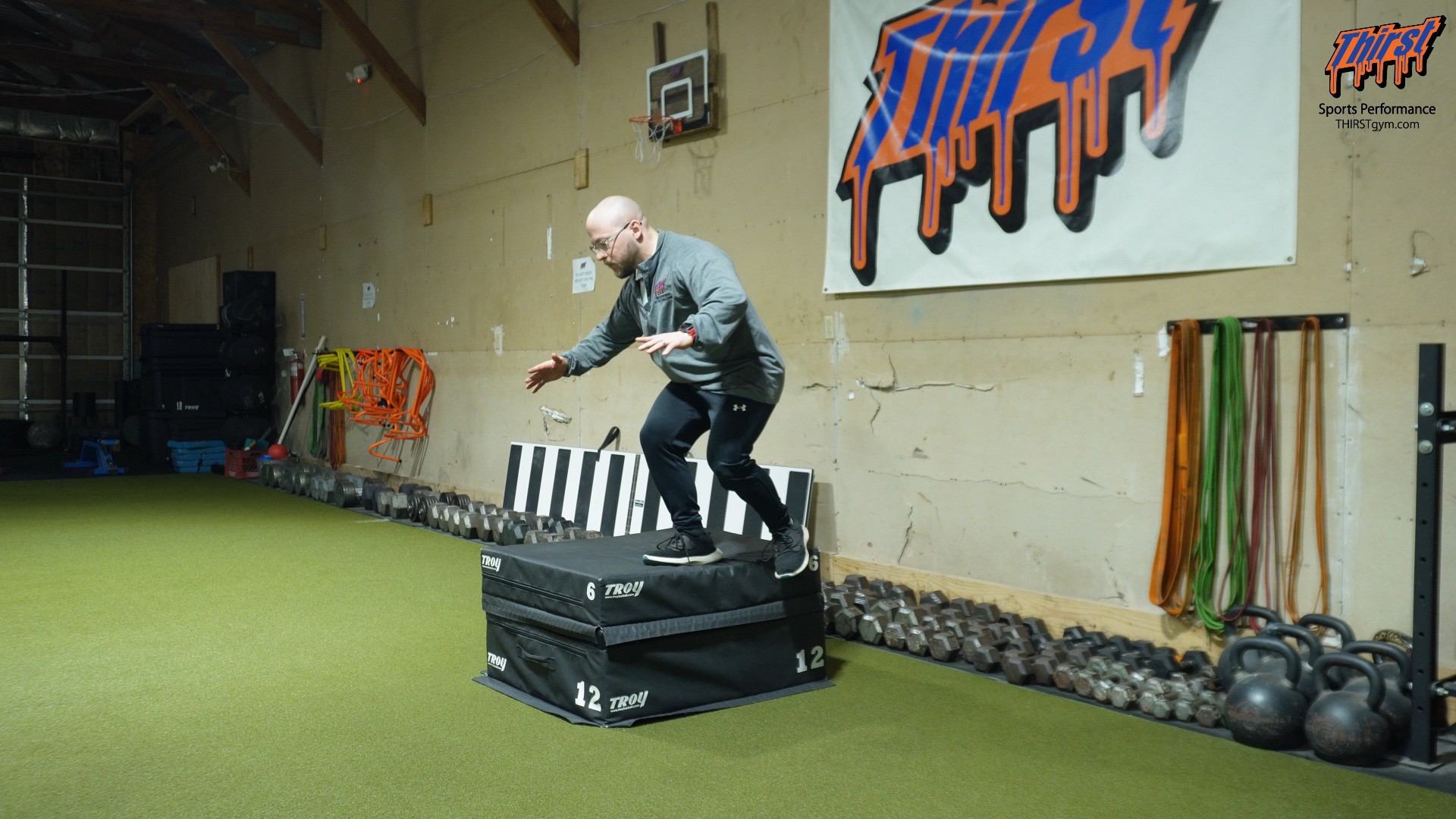
The Single Leg Lateral Box Jump: Building Frontal Plane Power and Hip Stability
Most athletes spend the overwhelming majority of their jump training moving in one direction: straight up and down. Vertical jumps, box jumps, depth jumps — all valuable, but all locked into the sagittal plane. The problem is that sport rarely happens in a straight line. Wrestlers scramble laterally, fighters cut angles, and field and court athletes are constantly pushing off one leg to redirect their momentum sideways. If your plyometric program never trains that quality, you’re leaving a significant chunk of athletic power on the table.
The single leg lateral box jump is one of the most effective ways to close that gap. It’s a demanding drill that develops unilateral power, frontal plane force production, and the kind of hip stability that keeps knees and ankles healthy under load. It also happens to be a brutally honest test of left-to-right symmetry. This article breaks down exactly what the exercise is, why it works, how to coach it, and where it fits inside a smart training program.
Watch the video below on how to maximize this exercise.
What the Single Leg Lateral Box Jump Actually Trains
At its core, this is a single-leg power drill performed in the frontal plane — meaning you’re producing force sideways rather than forward or straight up. You stand beside a plyo box, jump off one leg, and land on that same leg on top of the box. Every repetition asks a single limb to generate explosive force, control a lateral trajectory, and then absorb the landing without collapsing.
That combination is what makes the drill so useful. You’re simultaneously training three qualities that most athletes need more of. The first is single-leg power, since the takeoff comes entirely from one limb rather than splitting the workload across two. The second is lateral or frontal plane power, the ability to drive the body sideways with force, which is one of the least-trained expressions of athleticism in a typical gym. The third is hip stability, because the moment you land on one leg after moving sideways, the muscles around the hip — the glute medius in particular — have to fire hard to keep the pelvis level and the knee tracking properly. Train all three at once and you get a lot of return from a very small number of reps.
Why Frontal Plane Power Deserves a Place in Your Program
Think about how change of direction really happens in competition. To cut hard to the right, you plant on the left leg and push the body laterally off that single limb. Speed development coaches like Lee Taft have spent careers emphasizing that this “plant and push” mechanic is the true engine of agility, not the arm swing or the footwork that gets all the attention. The single leg lateral box jump trains that exact pattern in a controlled, measurable way.
For combat athletes, the carryover is even more direct. Wrestling and mixed martial arts are played almost entirely on angles — level changes, sprawls, lateral penetration steps, and constant single-leg loading during scrambles. An athlete who can express power off one leg while moving sideways has a real advantage in those positions. That’s a big part of why this drill earns its place in the kind of athletic development work we program for wrestlers and combat sport athletes.
What You’ll Need and How to Set Up
The equipment demands are refreshingly simple. You need a stable plyo box and a bit of open floor space to the side of it. That’s it. Choose a box height you can land on cleanly and under control — this is not the exercise where you chase the tallest box in the gym. Because the drill is lateral, position yourself standing beside the box rather than facing it, with enough room on the takeoff side to load and drive.
The Two Directions You Need to Train
Here’s the detail that most people miss. There are two distinct versions of this jump, and you owe it to your athletes to train both.
The first is the lateral version, where you move away from the body’s midline. If you’re standing to the left of the box with your right leg nearest to it, you jump from the right leg and land on the right leg while traveling outward — laterally, to the right. Your working leg carries you away from your own center.
The second is the medial version, where you travel toward and across the midline. Standing in that same spot beside the box, you now balance and jump from the left leg, landing on the left, which forces you to move medially — inward, across the body, to reach the box. This direction almost always feels more awkward because you’re covering the box with the far leg.
Both versions must be trained on both legs. Sport demands power in every direction, and these two patterns feel genuinely different under the hip. Skipping one is like only training half a movement. Label the directions however makes sense to you — lateral and medial is a clean way to keep them straight — but make sure all four combinations (each leg, each direction) show up in your training over time.
Coaching Cues and Landing Mechanics
The intent on takeoff should be aggressive. Drive the knee up hard and explode off the working leg — this is a power drill, not a balance drill, so there’s no reward for a timid, tentative jump. The magic, though, is in the landing. The goal is to stick it. Land on the same single leg, absorb the force through a soft hip and knee, and hold the position for a beat before resetting. A stuck landing tells you the athlete controlled the force they produced. A wobbly, stumbling landing tells you the drill is either too advanced or the box is too tall for that side.
That control on landing is where the hip stability payoff lives. Every time an athlete decelerates a lateral force on one leg and holds it, they’re strengthening the exact stabilizers that protect the knee during cutting and change of direction. Quality of landing matters more than height of box, every single time.
Using the Drill to Expose Left-Right Asymmetries
One of the most valuable things this exercise does is reveal imbalances you didn’t know were there. It is extremely common for an athlete to jump confidently in one direction and off one leg, then struggle noticeably with the opposite leg or the medial direction. That’s not a flaw in the drill — that’s the drill doing its job.
When one side can’t match the other, you have two honest options. You can lower the box height for the weaker side so the athlete can still perform quality reps, or you can treat that side as a targeted point of emphasis and give it dedicated attention over the coming weeks. Either way, you now have real information about where an athlete is vulnerable. Given that most non-contact knee injuries happen during single-leg deceleration and cutting, finding and addressing these asymmetries in the weight room is far better than discovering them in competition.
Programming: Sets, Reps, and In-Season Application
This is a low-volume, high-quality drill, and it should be programmed that way. A productive dose is two to three repetitions per leg in each direction, for anywhere from two to four sets. That’s plenty. Plyometric power work is about crisp, explosive, well-executed reps — the moment fatigue turns the jumps sloppy, you’re no longer training power, you’re just accumulating junk volume and undermining the landing quality that makes the exercise worthwhile.
The low volume is exactly what makes this drill so useful in-season. It lets you keep developing lateral, single-leg power without generating the kind of fatigue that would interfere with practice and competition. You get a meaningful training stimulus that’s easy to recover from — a rare and valuable combination when the calendar is full of games or matches. For coaches trying to maintain power output through a long season without beating athletes up, this fits neatly into a maintenance framework.
Who Should Do This — and Who Shouldn’t
Let’s be direct: this is not a beginner exercise. Landing single-leg lateral jumps demands a foundation of plyometric competence that new athletes simply don’t have yet. Putting a beginner into this drill is asking for poor landings and unnecessary risk.
The right path is progression. Athletes should first accumulate ample general plyometric work — two-foot hops, basic box jumps, controlled landings, and low-level bounding — until they can execute those cleanly and confidently. Only once an athlete demonstrates high-quality plyometric mechanics on simpler drills should you introduce single-leg plyometrics like this one. Think of the single leg lateral box jump as a way to advance an already-competent athlete into more demanding, sport-specific single-leg power work, not as an entry point.
Building Toward the Movement
If you’re mapping out a progression, a sensible sequence might start with double-leg landings and general plyometrics, move to double-leg lateral hops over a low line or hurdle, progress to single-leg linear hops and controlled single-leg landings, and only then arrive at the single leg lateral box jump. Regress it by lowering the box or reducing the lateral distance; progress it by raising the box modestly or adding a small approach. The exercise scales well in both directions, which is part of what makes it a keeper.
Final Thoughts
The single leg lateral box jump packs an unusual amount of value into a handful of reps. It builds frontal plane and single-leg power, hardens the hip stabilizers that protect your knees, and gives you an honest read on left-to-right symmetry — all while being gentle enough on recovery to run in-season. Respect the prerequisites, obsess over the quality of every landing, and train both legs in both directions, and you’ll have a tool that pays off well beyond the gym.